|
Philippines, 22 Jul 2026 |
Home >> News |  |
|
||||
|
|
|
|
A Filipino Champion’s Last Fourth of July: A Visit to Oaks Ball Park By Emmanuel Rivera, RRT PhilBoxing.com Thu, 02 Jul 2026 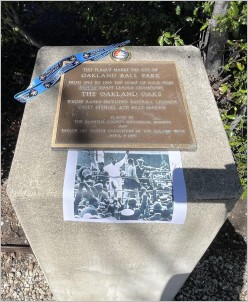 Emeryville, California — It has been one hundred and one years after Pancho Villa fought the final bout of his extraordinary career. And this week, I finally made my way to the site where Villa fought his last round against Jimmy McLarnin. Today, there is no grandstand…no squared circle…nor cheering crowd. There was only a bronze plaque quietly marking the former site of the historic Oaks Ball Park. As America prepares to celebrate its 250th anniversary this Fourth of July, I found myself thinking not only about American Independence Day, but about a young Filipino who became part of America’s story and the birth of the United States of America back in 1925. Most baseball fans remember Oaks Ball Park as the longtime home of the Oakland Oaks of the Pacific Coast League. Before the Oakland Athletics arrived and left across the bay and long before professional sports like the San Francisco Forty-niners and Giants transformed the Bay Area, this was one of California’s great sporting venues. On July 4, 1925, baseball gave way to boxing— the King of Sports. A ring was installed on the baseball field, and more than 13,000 spectators gathered to watch the world’s flyweight champion, Francisco “Pancho Villa” Guilledo, defend his belt and reputation against future hall-of-famer nineteen-year-old Jimmy McLarnin. Nearly 5,000 Filipinos were reportedly in attendance, making the afternoon more than a prizefight. It became a celebration of Filipino pride who saw one of their own standing atop the boxing world. The symbolism was remarkable. Only twenty-seven years had passed since the United States acquired the Philippines following the Spanish-American War. 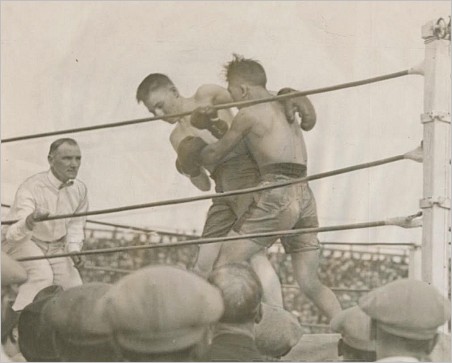 (L-R): Referee Bobby Johnson, Jimmy McLarnin and Pancho Villa at Oaks Ball Park (July 4 1925, Unknown artists, Public Domain) Historically, thousands of Filipinos had crossed the Pacific seeking opportunity, particularly in California. On America’s Independence Day, their greatest sporting hero stood in the center of an American ballpark wearing the crown of world champion. Unknown to much of the public, Villa entered the ring seriously ill. A severe infection caused by an ulcerated wisdom tooth had spread through his body. His physician, dentist and his camp urged him not to fight, and promoter Tommy Simpson knew firsthand his champion’s face was badly swollen. Villa refused to disappoint the fans who had traveled from far and wide to see him in action and insisted that the contest go on. History has long debated whether that decision cost him his life. It almost certainly did. Ten days after his last stand, Francisco Guilledo died on July 14, 1925 due to a raging sepsis of the throat cavity, later diagnosed as Ludwig’s Angina which claimed the life of boxing’s first Filipino and Asian world champion at just twenty-three years old. 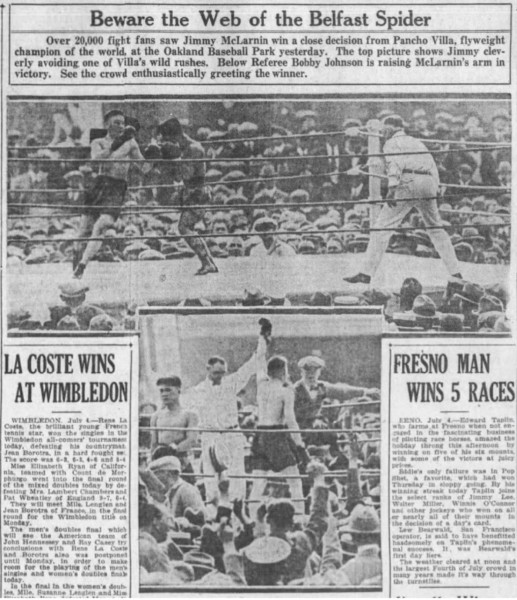 Source: San Francisco Examiner, Sunday, July 25, 1925 (Public Domain) 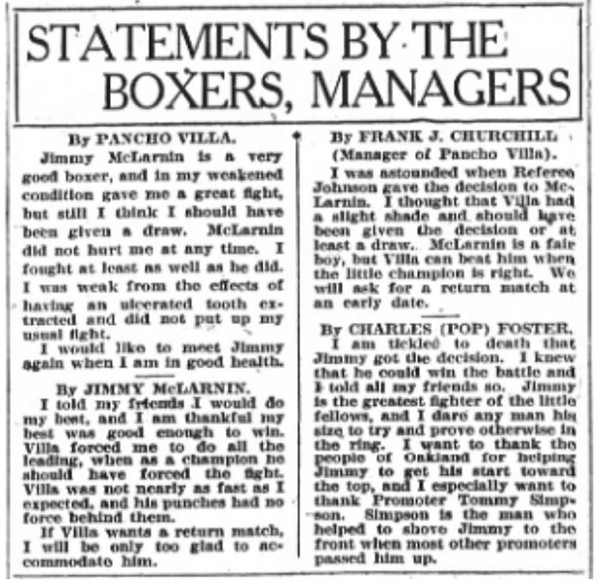 Source: Oakland Tribune, July 5, 1925 (Public Domain) The official decision favored the young McLarnin, who would become one of boxing’s immortals, though the outcome has been debated by ringside reporters and aficionados. What endured was Villa’s courage and unwavering sense of responsibility. He kept his promise to appear, even when every medical voice around him urged otherwise. It was, in his heart, the least he could do so his fellow Filipino American immigrants— farmers, factotums, sailors, soldiers and all-around workers— would not be disappointed with a postponement. Legendary writer Damon Runyon perhaps said it best after Villa’s death, writing that fighters like him “come along at rare intervals.” Championships are eventually won and lost. Legends are remembered for something greater. 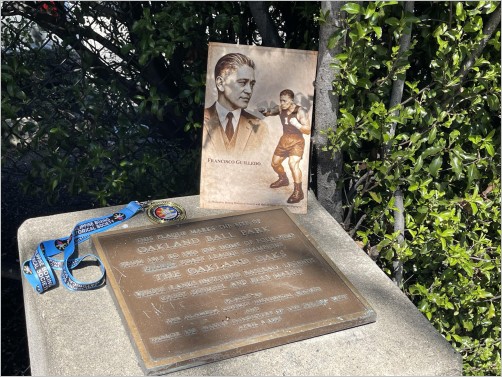 Standing before the plaque this week, I placed beside it a photograph of Pancho Villa and the lanyard of the Philippine Boxing Historical Society and Hall of Fame. For a moment, as I touched the tombstone-like memorial, history came alive in my mind's eye. The plaque commemorates baseball. But the hallowed ground remembers boxing. 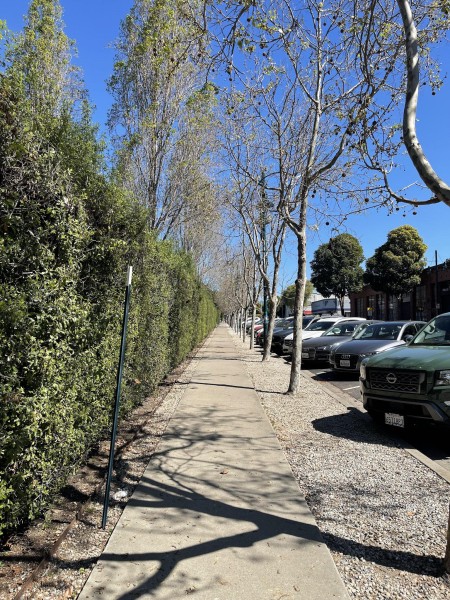 Somewhere beneath the trees and across the pavement, thousands once rose to their feet and screamed to the high heavens as a Filipino champion fought for the last time. Most people who pass this marker today have no idea that one of the greatest athletes in Philippine history competed here. Today, a multi-billion dollar studio looms large on its grounds, surrounded by an imposing arch complete with high tech security fencing. Few realize the gated facility owned by Pixar Studios was sacred ground in the history of Filipino boxing. As America celebrates its 250th birthday, it is worth remembering that its sporting heritage belongs not only to baseball, football and boxing champions, but also to the adoring fans of sportsdom..the immigrants whose achievements became part of the Philippines and American history. Memory survives only if we, boxing fans, continue retelling such stories. 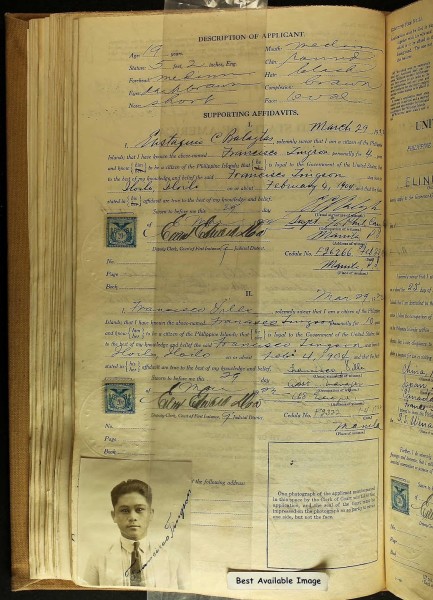 Passport Application of Francisco Tingson Guilledo (1924). Courtesy of the National Archives and Records Administration (NARA). Public Domain. Francisco Tingson Guilledo has become a perpetual Filipino-American folk hero, but on one Fourth of July, inside an American ballpark, he became part of America’s story as well. Oaks Ball Park is long gone. But the memory of our first Filipino world champion in any sport, Pancho Villa, remains. Click here to view a list of other articles written by Emmanuel Rivera, RRT.  |
|
|
PhilBoxing.com has been created to support every aspiring Filipino boxer and the Philippine boxing scene in general. Please send comments to feedback@philboxing.com |
PRIVATE POLICY | LEGAL DISCLAIMER
developed and maintained by dong secuya © 2026 philboxing.com. |