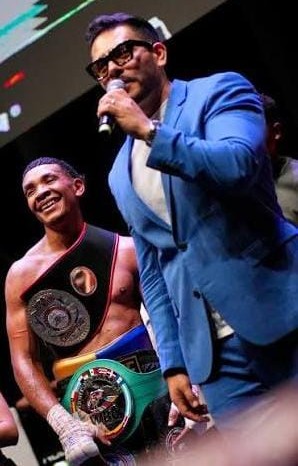
Oscar De La Hoya, who registered many big knockouts in the boxing ring, scored perhaps his biggest as fight promoter this week.
De La Hoya, the owner of Golden Boy Promotions, was the driving force in prized pupil Saul “Canelo” Alvarez’s surprising jump from Showtime to HBO. Since the abrupt departure of former CEO and friend Richard Schaefer in June, De La Hoya has steadfastly assumed the role of decision maker.
De La Hoya’s brokering of the lucrative Canelo-HBO deal instantly changed the boxing landscape. With Floyd Mayweather Jr. in the twilight of his career, the move shifted the balance of future power back to HBO. It also lessened the impact of influential boxing advisor Al Haymon and suddenly weakened rival Showtime’s gathering momentum. Future of boxing?
Since emerging from a stint in rehab earlier this year, De La Hoya has ushered Schaefer out the door and rekindled a soured relationship with former promoter and current competitor Bob Arum of Top Rank. As a result, a host of huge fight possibilities exist for boxing fans, including Canelo fights with Top Rank allegiances Miguel Cotto, Julio Cesar Chavez Jr. and Manny Pacquiao.
Further, with Mayweather Promotions in apparent disarray, De La Hoya could be one of only a few people with a reasonable chance of assembling a Mayweather-Pacquiao fight.
He clearly has some business chops.
But De La Hoya has a far bigger opportunity than putting together the fight of the century. Advertisement
Back in the 1970s and early 1980s, major fights could be seen by millions of viewers on free network television. Whether it was ABC, NBC or CBS, boxing was relevant. Muhammad Ali, Larry Holmes and Sugar Ray Leonard were superstars.
But with the advent of premium cable in the early 1970s, boxing began to slowly fade from the consciousness of the everyday sports enthusiast. Suddenly, marquee fights required cash. Matchups that were previously shown for free on Saturday or Sunday afternoons ? or even on prime time ? now came with a price of an HBO or Showtime subscription.
In 1990, the cable boon prompted boxing promoters to charge for certain fights on a pay-per-view basis. This practice enabled promoters and premium cable channel executives to get rich ? but put a death knell in boxing’s ability to remain viable to the mainstream sports fan.
As a result, outside of a hard-core set of enthusiastic-but-ever-graying aficionados ? the sport is often invisible to the average Joe.
De La Hoya ? who ironically benefited from the pay-per-view age ? has long said that he is dedicated to the long-term health of the sport. So, sometime in the next few years, perhaps he will use his connections to broker another deal ? this time with network TV executives.
It would be an unprecedented opportunity to be a game changer and introduce boxing to a whole new generation of fans. Game changer
It won’t be easy. The money that is currently made via pay-per-view will not be generated on network television. A return to free TV would have to be seen as a long-term investment in the future.
Promoter Main Events put a card on last weekend on NBC, and continues to plug away toward respectable results. But the push could certainly use De La Hoya’s help.
What would be the outcome? Who knows? But if the Super Bowl, World Series, and NBA Finals can be televised on network television, it’s worth pondering the possibilities if Canelo vs. Cotto did the same.
Matthew Aguilar may be reached at [email protected]; follow him on Twitter @MatthewAguilar5.