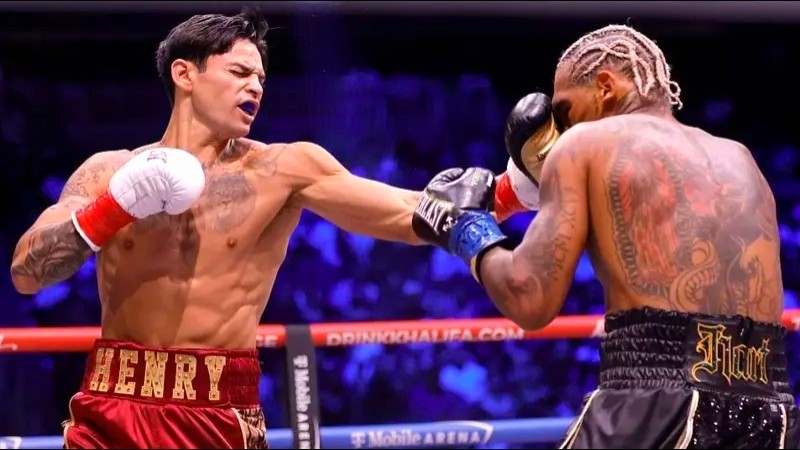
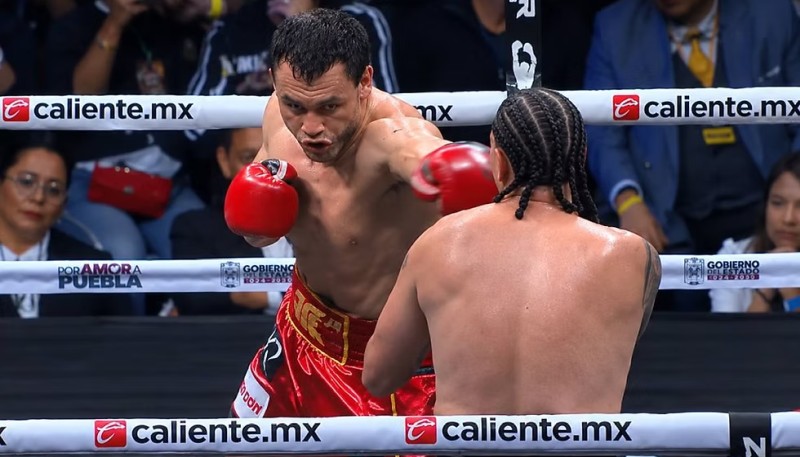
Side by side, Erik Morales and Manny Pacquiao look like those Greek theatre masks of Tragedy and Comedy.
Morales, with his hollow-eyed, hawk-nosed glower, seems to personify all the pain and cruelty and effort of professional prizefighting. Pacquiao, with his round cheeks, wispy mustache and twinkling smile, projects nothing so much as the sheer joy of being young, strong and blessed with the opportunity to punch the daylights out of someone.
They head into their third match Saturday night in Las Vegas — Morales won the first, in March 2005, on a close but clear decision after a brutal 12 rounds, while Pacquiao took the second, last January, with an emphatic 10th round TKO, the first time Morales had ever been stopped.
The two 130-pounders stand as opposites in terms of career trajectories as well. The 30-year-old Morales (48-4-0, with 34 KOs) has been one of the bravest, most accomplished fighters in boxing for more than a decade, winning world titles in three weight classes. But he has also lost three of his last four bouts (and gone through hell in all of them). Pacquiao (42-3-2, 33), by contrast, is 27, and seems to be getting better with each outing, bringing his prodigious power and speed to bear with increasing control and ring craft.
All signs point to an easier and probably quicker KO by Pacquiao (assuming, that is, that Morales, who nearly evaporated himself in the effort to come in under 130 pounds for the second bout, makes weight this time; he is bound by contract to pay Pacquiao a half-million bucks for every pound he is over the limit at Friday’s weigh-in).
Yet, I am eager to see this fight — and all indications are that I’m not alone. At the risk of trotting out a clich?, there’s an old-school attraction to this one. This is a bout that doesn’t need to be hyped. Yes, Morales would appear to be on his last legs, but anyone who has seen this fierce, arrogant warrior — who is also one of most technically proficient, resourceful fighters of his era — in any of his great fights, especially the astounding trilogy against Marco Antonio Barrera, knows that Morales will bring everything he has in terms of skill and heart. And anyone who has watched the whirlwind that is Pacquiao emerge on the world-class level, has to be hungry to see what this prodigy will do next.
That Morales-Pacquiao III comes this week, when the other big news in boxing is that Floyd Mayweather Jr. and Oscar De La Hoya have signed to fight next May, provides an interesting contrast. Mayweather-De La Hoya (which comes ready-equipped with the almost-too-perfect tagline of Pretty Boy vs. the Golden Boy) will almost certainly do huge numbers, as they say, at the box office and on pay-per-view. But the bout is also — unlike Morales-Pacquiao — the embodiment of much of what’s wrong with boxing these days.
Sure, Mayweather is probably the most gifted, most complete fighter in the game today. And De La Hoya is pretty darn good in his own right. But because of the megabuck bottom line realities of the way the sport is run these days — with so much at stake, matchmaking becomes very risk-averse and there’s an immense premium on being undefeated — these two superstars arrive at their career-defining showdown not quite the fighters they could have become.
As Carlo Rotella, the author of Cut Time: An Education at the Fights and a clear-eyed observer of the sport, writes on The Boxing Standard (theboxingstandard.com):
“As boxing careers have gotten shorter … it gets harder and harder to judge just how good a fighter is, or could have been. … How good is Mayweather? Well, if he’d fought [Jose Luis] Castillo, [Diego] Corrales, and a bunch of other tough guys three or four or five times, it would be a lot easier to say. … Going 5-1 [against one or two of those] would do Mayweather more good, in the long run, than going 1-0 vs. [Arturo] Gatti or Oscar De La Hoya, which will mean exactly nothing in the all-time scheme.”
Thankfully, that’s not the case with Morales or Pacquiao. Neither may be quite the superstar that Mayweather or De La Hoya is, but is there any doubt that either is going to retire without getting — and giving — the best of himself? Win or lose, it makes for great theatre.