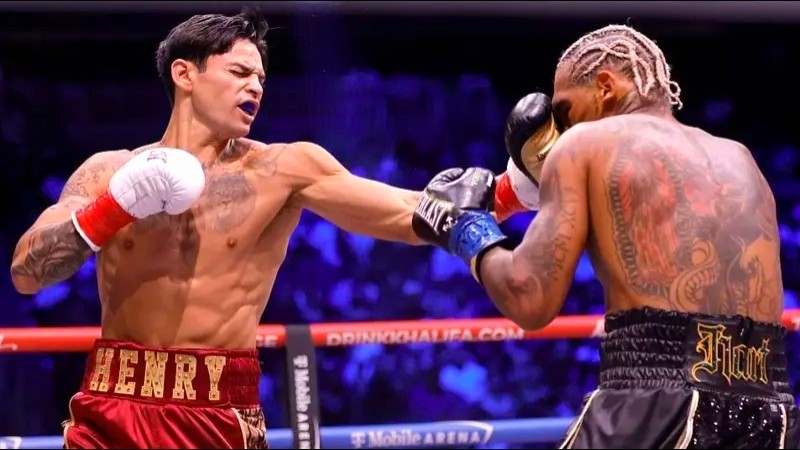
Boxing is said to be a dying sport, yet the buzz for a Manny Pacquiao-Floyd Mayweather Jr. welterweight showdown is already building to a fever pitch ? and the fighters haven’t even agreed to fight each other yet. Pay-per-view buys already have been calculated at record numbers ? and there is no date, no site, no contract. If boxing is, in fact, dying, a Pacquiao-Mayweather welterweight mega-fight figures to be one hell of a death rattle.
The first time I ever heard of a welterweight title fight was March 24, 1962, when I was 14. Emile Griffith and Benny Kid Paret fought for the third time, and Griffith regained the title with a 13th-round knockout. But what made the fight memorable, what made it horrific, was that Paret died from the beating.
In the heavyweight void left after the Muhammad Ali era, it was the welterweight division, relative little guys (147-pound limit), that showcased some of the most dynamic fighters and some of the most memorable championship bouts in boxing history. If Pacquiao-Mayweather does come off, it will have to measure up to the following:
Sugar Ray Leonard vs. Roberto Duran, June 20, 1980. Called the Brawl in Montreal, for good reason. Duran pounded out a close but unanimous decision, but Leonard stood up to the ?Hands of Stone,? stood toe-to-toe, and his survival, his nearly winning despite what appeared to be strategy that was more foolhardy than macho, gave him immense confidence and laid the groundwork for the rematch. Just five months later, on Nov. 25 at New Orleans, Leonard knew he could go toe-to-toe again if necessary, but now he adapted. He used his hand and foot speed to frustrate Duran, who wouldn’t adapt, couldn’t adapt, had no idea how to adapt, which led to his infamous ?No mas? in the eighth round.
Leonard vs. Thomas ?Hit Man? Hearns, Sept. 16, 1981 at Las Vegas. This is one of the most curious narratives in the history of championship bouts. For the first half of the fight, Hearns was the aggressor and Leonard was skillfully but constantly in retreat, usually avoiding punishment but not always. It almost looks like a mismatch. In the middle of the bout, the roles changed. Leonard landed and suddenly became the aggressor, and a hurt and tired Hearns assumed full-retreat mode. And so it went until late in the 14th round, when the referee stopped the fight. Leonard prevailed, masterfully. Fascinating fight.
When Leonard, Hearns and Duran joined Marvelous Marvin Hagler in the middleweight division, Aaron Pryor proudly carried the welterweight banner (or light welterweight, to be absolutely accurate).
Pryor vs. Alexis Arguello, Nov.12, 1982 at Miami. Pryor was a muscular, finely tuned bundle of kinetic energy. He threw punches nonstop from every conceivable angle, and a few inconceivable angles, too. Arguello was a former featherweight, super featherweight and lightweight champ of noble bearing and ring generalship. The bout was a vivid illustration ? over 14 rounds of violent high drama ? of a young athlete just coming into his prime defeating an older athlete a bit past his prime. Ten months later in Las Vegas, Pryor and Arguello staged a rematch, which was really a rerun, only four rounds shorter.
There are memorable fights, historic fights and hyper-anticipated fights. Rarely is there a fight that combines all three adjectives. It’s highly unlikely Pacquiao-Mayweather will ever be viewed as historic. Jack Johnson knocking out former champion Jim Jeffries 100 years ago was historic. Joe Louis’ first-round knockout of Max Schmeling on the eve of World War II was historic. Ali-Frazier I was historic (two undefeated champions) and even Tyson-Berbick was historic (youngest heavyweight champion ever).
But Pacquiao-Mayweather? In terms of money generated, it will certainly break records, but history has to have more gravitas than profit margin. But Pacquiao-Mayweather doesn’t have to be historic. It would be nice if it’s memorable. It would be nice if occurs.
Robert Rubino can be reached at [email protected] or 521-5261.