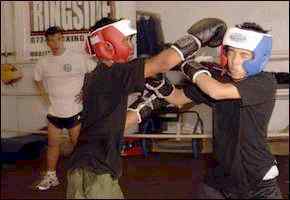
For Jarvis Ladrido, he had no choice but to get into boxing.
His seven uncles boxed — three of them earning world rankings in the 1970s — and whenever he would return “home” to Iloilo City in the Philippines for summers and Christmas vacations, all his friends in the family’s neighborhood would box.
The kids shadow boxed at home, scrapped in the streets or would run to the nearest gym for their turn at a ragged leather bag or a chance to put on some headgear and spar in the ring.
Boxing is one of the most popular sports in the Philippines. The magnitude of that popularity was expressed recently when Philippines President Gloria Macapagal Arroyo congratulated boxer Manny Pacquiao on his victory over Mexico’s Hector Velazquez on national television. She called his fight “the fight of all Filipinos” and something “the whole nation is celebrating,” according to an Associated Press story.
It says a lot when an entire nation celebrates a boxer’s exploits, so it’s easy to see why Filipino ex-pats have brought their love for the “sweet science” over to Guam.
“The Filipino community is definitely our biggest supporters — they’re always out at all our amateur events, and they help keep us (motivated),” said the 20-year-old Ladrido. He is a 5-foot-4-inch, 140-pound fighter with a 4-1 record, who has hopes of a professional career.
Errol Alegre coaches fighters, including Ladrido, who train at the Guam sports complex gym. He is a former professional fighter who won a bronze medal at the 2000 Oceania Boxing Championships.
Alegre, whose family moved to Guam from the Philippines when he was a child, said most of the fans at the island’s amateur and professional boxing events are from Guam’s Filipino community.
“Well, the sport, it’s been around for a long time, and in the Philippines, it’s very big — it’s probably the No. 1 sport or at least goes hand-in-hand with basketball,” the 39-year-old said.
“I think that’s carried over to here, because the fans, they always followed the Filipino boxers out there, so they try to stay close to it here. I remember a couple years ago when we brought in a couple of fighters from the Philippines and they just came out in force to watch these guys and some even gave them their money.”
Filipino Community of Guam president Nita Baldovino said there is a lot of national pride in boxing.
“I think, especially now with guys like this Manny Pacquiao who won the big fight, it is very big in the Philippines — I’m still watching the Filipino channel, and everyone is so big into it,” she said.
“But it isn’t as big here as it was, I think, because they do not have the professional fights like they used to, but I think with all the (publicity) now, I think it will come back. With 40,000 Filipinos, we have a lot of people interested, and we are all proud that we have Filipinos who are doing so well.”
Long history That popularity comes from the success the Philippines has had in producing world-class fighters, Alegre said. Starting in the early 1920s with Francisco “Pancho Villa” Guilledo, 25 Filipinos — most recently Pacquiao with the IBF junior featherweight title in 2003 — have held world championship belts, and several others have been ranked in the top 10.
Pacquiao, who has since moved up to the super featherweight class, was recognized by Ring Magazine as the world featherweight champion, although he didn’t hold a title with any of the three major sanctioning bodies.
“You look at the popularity of a guy like Manny Pacquiao. He’s so popular that he draws the community out to watch him. When he fought in Vegas for the championship, even the president flew out to watch him,” Alegre said.
“I think with the second-generation kids here on Guam, they are not die-hard; it’s more entertainment for them, but they watch. I think, because with the family watching, they get into it and they become interested themselves. That’s why we have a lot of young people coming out to try,” he said.
One such young person is 13-year-old Yigo resident Chad Alianza, who trains under Alegre and his mentor, Joe Saloma, at the Guam sports complex gym. The half-Filipino, half-Chamorro fighter has been training for four months and got into the sport after watching the NBC reality television series “The Contender.” Alianza said he’s really learned a lot about the sport from Saloma, and is even getting a few history lessons from the former fighter.
Agat resident Andrew Solidum said he’s not a big boxing fan, but he does pay attention when Filipino fighters like Pacquiao or Brian Villoria are in the ring.
“I keep track of them because they are Filipino, and I’m proud of their success, but it’s something that my dad introduced me to,” the 26-year-old said.
“My dad and his brother kind of grew up with it, and they still kind of keep track of what’s going on — they would ask me (once in a while) to check on the Internet for results. But, yeah, he got me into it. I remember when I was younger we’d watch it when they showed fights on TV, and then I started to learn about all these Filipino boxers in the Olympics and in the pros and I kind of started to follow it on my own.”
Part of growing up Saloma — a former professional fighter who retired in 1973 who said he reached the No. 8 ranking in the world in the WBC’s super bantamweight division — is one of Ladrido’s uncles, and he said fighting is just something you do growing up in the Philippines.
“It’s in the blood and there’s a gymnasium in every city. I remember my father used to drive us around the villages with two pairs of boxing gloves — a smaller amateur set and a bigger one — and we would box. Actually, that’s how my brothers Colley, Eddie and I first got known,” said Saloma, whose brothers also were professional fighters.
Big family “My father had seven boys and three girls and he got us into boxing to teach us discipline and to keep us out of the streets, and that is the same for a lot of people. So people just love it there and that’s carried over to Guam. In the late sixties and early seventies, a lot of us fighters would come to Guam to train and fight and then a lot of us, like myself, got married here and settled down here. But over the years the sport has really died out.”
Saloma said that’s why it’s so important that boxing continues to have the support of the island’s Filipino community, and he’s looking to bring back a lot of the other boxing fans that have since turned their attention to other combat sports such as mixed martial arts.
Bouts coming up To do so, Saloma, a Department of Corrections officer, is working with Leo-And International Entertainment to bring several professional fighters from the Philippines, Korea and Taiwan for a boxing event Oct. 7 at the Guam sports complex gym.
It’s also why he works to make the training gym he started with Nomer Alegre — Errol Alegre’s brother — so affordable. Saloma said gym membership is only $20 a year, and the gym is open 6 to 8 p.m. Monday through Friday. With a small ring, weights and ample heavy and speed bags, Saloma and the Alegres take their time to train not only second-generation boxers like Ladrido but anyone interested in the sport.
“People here have the heart for the sport, and we already have a fan base that we just need to wake up,” he said.
“We need support from the government or sponsors because, with the right support, we can produce world-class fighters here on Guam.”