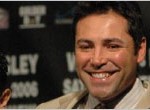
Just a few days after Oscar De La Hoya?s retirement, a search is underway, inevitable as it is unfortunate. Already, there is a hunt for the next Oscar. But there is no De La Heir Apparent.
Yet, names of potential successors are beginning to appear. Manny Pacquiao is at the top of the list. Pacquiao was the last one to beat the man, so he should be the man. That, at least, is the thinking. Not far behind and in no particular order, there is Victor Ortiz and James Kirkland and Chris Arreola.
Can we just stop it, please? With apologies to Kobe Bryant and LeBron James, nobody ever found the next Michael Jordan. I suspect there will never be another Tiger Woods. The only sure successor is a knee-jerk temptation to always look for one.
But it?s not fair to Pacquiao or Ortiz or Kirkland or Arrealo or anybody else. Besides, I?m not sure they want to be the next Oscar any more than they want to be an Elvis impersonator. De La Hoya?s chapter in boxing history stands alone. Dollar-for-dollar, it does, in part because it developed in its own way.
For all of his faults in the ring, De La Hoya?s looks and natural grace filled a theatrical role that attracted an audience in numbers no other fighter in his generation and few others ever could. Crowds didn?t necessarily come to see him fight. They just came to see him. He was the flip side to Mike Tyson?s craziness ? perverse, yet a powerful attraction because of it.
It?s impossible to identify the face or faces that eventually and inevitably will come to personify boxing in the post-Oscar era. There have been some predictions that De La Hoya?s retirement means an end to the sport, but I suspect some of those obits have come from the crowd that has written them before. The guess here is that boxing will be around a lot longer than newspapers.
For now, De La Hoya?s exit to the promotional side of the ropes represents another step, a milestone, in a sport that is becoming more and more international. To wit: Top Rank?s posted schedule. There is a card on Sunday in Manila. On April 25, there is one in Puerto Rico. Top Rank?s two biggest cards are in the U.S., but only the postal code makes them American. On May 2 at Las Vegas? MGM Grand, the main event features Pacquiao, a Filipino, against Ricky Hatton, a Brit. On June 13 at New York?s Madison Square Garden, it is Miguel Cotto, a Puerto Rican, against Joshua Clottey of Ghana. The sun never sets on the British Empire or boxing.
Floyd Mayweather Jr.?s likely comeback could put an American star back into the ring. But there have always been doubts about Mayweather?s clout at the box office. He has done some good numbers, but only when partnered with De La Hoya and then Hatton, who brings a British Invasion with him.
There is no way to forecast what will immediately become of boxing without an acknowledged American star. There might be some 16-year old amateur in waiting, preparing to storm onto the stage with punches and personality that are right for the time.
An emerging Mexican and Mexican-American population carried De La Hoya to heights he could not have imagined when he came home from Barcelona with a 1992 Olympic gold medal. It will happen again, somewhere and somehow, but without a list of potential successors and without a blueprint on how to pull off an Oscar encore.
Notes, quotes and oddservations
? De La Hoya?s abilities as a fighter have been undercut by key losses ? twice to Sugar Shane Mosley, once to Bernard Hopkins, once to Felix Trinidad, once to Mayweather and once to Pacquiao. Years from now, however, respect for De La Hoya, the fighter, might be resurrected for two victories ? an 11th-round stoppage of Fernando Vargas in 2002 and a split decision over Ike Quartey in 1999. Against Vargas, De La Hoya showed great maturity and poise in a dramatic stoppage of a disliked, trash-talking rival. A personal favorite was De La Hoya?s victory over Quartey. There wasn?t much pre-fight hype, mostly because Quartey is from Ghana. But De La Hoya was at his fundamental best, especially in the way he got up from a jarring knockdown in the sixth-round.
? In a conference call Tuesday after the announced retirement in Los Angeles, De La Hoya said his worst moment was the loss to Hopkins. Hopkins? paralyzing liver shot has to be a painful memory. But for everybody else, the worst moment in De a Hoya?s career was his flabby decision in 2004 over Felix Sturm, who got robbed of a victory.
? An overlooked De La Hoya legacy is the way he opened the door for fighters to take more control of their own careers. Golden Boy Promotions has led others into trying to do more for their money than just taking the punches.
? HBO?s sensational documentary, Thrilla In Manila, helps restore the Ali-Frazier rivalry as the best in boxing, if not sports. Ali-Frazier took a back seat to George Foreman?s loss in 1974 to Ali in Africa because of another terrific documentary in 1996, When We Were Kings, which became the centerpiece to a 2001 Hollywood film, Ali, starring Will Smith.