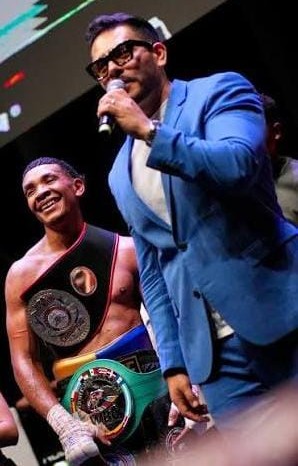
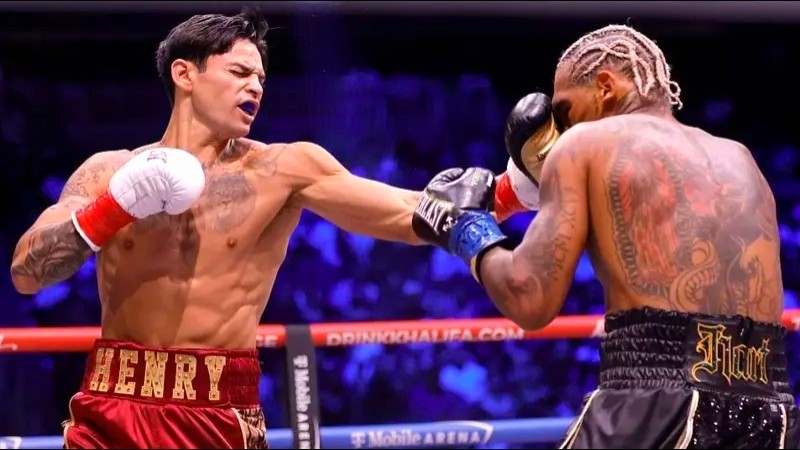
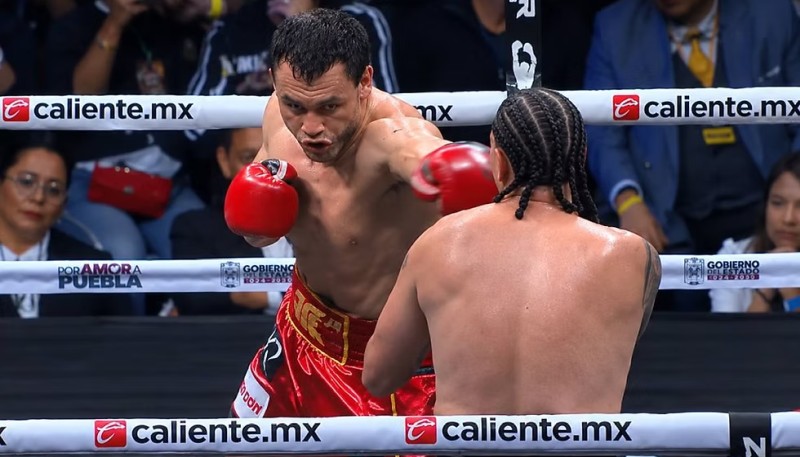
Marco Antonio Barrera Tapia was born January 17, 1974 in Mexico City, Mexico. At the ripe young age of 15, the Mexican embarked upon a legendary career rivaled only by former fistic greats Salvador Sanchez and Julio Cesar Chavez. For many Hispanics, the young Barrera was viewed as AmerICAN rather than MexICAN. Ironically enough, both cultures now embrace the great fighting legend as ICON, seeing he has proven over and over again, that he can, he did and he would. After amassing 33 consecutive victories against mainly non-descript foes, ?the Baby Faced Assassin? was pitted against Eddie Cook on December 3, 1994. Barrera won via 8th round TKO, and garnished himself a shot at the marginal WBO junior featherweight champion Daniel Jimenez.
Marco Antonio Barrera was to the World Boxing Organization in 1995, as Larry Holmes was to the International Boxing Federation in 1983. Though Barrera won quite handily by scores of 115-112, 116-111 and 117-110, he had failed to impress many of his native countrymen in going 35-0, with 24 KO?s. Nonetheless, a fighting machine was born; a legend was ascending; and boxing was buzzing every time Barrera fought with that Tapia name on the back of his trunks. Marco Barrera made four relatively anonymous title defenses against Frank Toledo (TKO 2), Maui Diaz (TKO 1), Agapito Sanchez (W 12) and Eddie Croft (TKO 7) before the entered the ring on a nationally televised HBO bout with American heartthrob Kennedy McKinney on February 3, 1996. A new programming product made its debut that night ? Boxing After Dark ? and the rest is history.
HBO under the tutelage of Lou Dibella was as good at being bad as Barrera was at punching in bunches. America fell in love with Marco Antonio Barrera that February night. Though he was knocked down himself in the 11th round, he roared back in an old fashioned boxing barnburner to drop McKinney for a 5th time in the fateful 12th round. After failing to land any major fights, Barrera stayed busy with three additional title defenses against former Olympic champion Jesse Benavides (KO 3), Orlando Fernandez (TKO 7) and old trail horse Jesse Magana (KO 10). Then the wheels fell off the Barrera bandwagon. Though seemingly a step behind, and a punch short the entire fight, Barrera made ground in his dual against Junior ?Poison? Jones.
When November 22, 1996 passed, two things became clear. One, Barrera couldn?t muster the same magic on HBO?s World Championship Boxing telecast; and two, Junior Jones exposed Marco Antonio Barrera as a one dimensional fighter. I know the official verdict that night in Tampa Florida was a disqualification at the end of five rounds, but the truth is Barrera?s corner stopped him from a TKO loss. Like many fighters before him ? and several notable boxers after him (i.e. Mosley and Forrest) ? Marco Barrera insisted upon an immediate rematch with his conqueror Junior Jones. April 18, 1997 came, and once again, HBO was glad to have Barrera back on B.A.D.
Jones boxed beautifully at times; waned in moments; almost was stopped; but ultimately hang on to retain his WBO title via close unanimous decision over Barrera by scores of 116-11, 114-113 and 114-112. Marco Barrera found himself 43-2; having lost two fights in a row; without a title; having no network; no major contract; and the ill repute status of a Chavez wanna-be. He was lamented by the faithful and lambasted by the fickle. At a striking 23 years of age, many boxing authorities, the sanctioning bandits (I mean bodies) and journalistic experts called on him to retire.
Then he went and did it again. Whoever wrote the immortal words ? yea, whichever wise old sage wrote the proverbial phrase ?you can?t teach a dog new tricks? ? never met Marco Antonio Barrera. Juxtaposed between his failing boxing career and his thriving educational development, was a brilliantly conceived plan and technically proficient trainer named Rudy Perez. I must admit as a boxing fan first and fight game writer second that I often wonder how boxers psychologically handle the losses that they incur in their careers. Many remain in denial, while others offer excuses. Rarely do they actually become better fighters after having had lost. I know firsthand it is more fun to watch a fight than to be in one. When you win, you?re the man; and when you don?t, you?re a wimp. People tend to also talk better fights than they make.
That being said, I vividly remember what my grandfather told me when I was little, after I had fought three kids out of the same family ? all in a row, eventually all at the same time. He said, “Peck, you better watch out for those cats you have to pull off you more than once. Spook one, or hit ’em right, and most will run. But when they keep coming back, that ain?t no fun.? What he was trying to tell me was there are some guys you may whip once, real good. Then they heal up and they are ready to go at it again. You best bet those are the guys that eventually are going to whip you. It is best to make friends with the guys you fight, because it isn?t fun losing more than you win. Parenthetically, I segue.
Marco Barrera proved what kind of man, boxer and fighter he was by how he prepared himself to correct what he could, and perfect what was lacking in his physical regime. With the exception of Muhammad Ali, I cannot recall another major fighter in boxing history who so successfully reinvented himself in another boxing style as seamlessly and successfully as Marco Antonio Barrera did. He literally went from a bruising banger and pressure fighter, to a methodical boxer, technical fighter and economical slugger. He became more coordinated; he employed head and body movement; he introduced a rhythmic blend of lateral balance, timing and ring generalship that few thought that he had in him. When he returned to the prized ring on February 21, 1998 against Angel Rosario, the result was definitely similar (TKO 5). How he won drastically changed. Barrera became a Mexican boxer ? that makes as much sense as a Chinese jelly bean.
Fans were quick to criticize the new style as tentative and reserved. By the time Barrera had notched three victories, he was matched with Paul Lloyd for the vacant WBO junior featherweight title. ?The Baby Faced Assassin? made quick order of Lloyd, stopping him via 1st round TKO. Whereas Barrera had made eight title defenses of his Puerto Rican based WBO title, his second tenure proved to be much more fruitful. Two defenses followed, and then ?The Fight? was signed, sealed and delivered. Amidst Barrera?s duplicate losses to Jones, the backdrop for a new kid in town was set. Erik ?El Terrible? Morales had quickly and impressively amassed quite a following in his native Tijuana, Mexico. However, when the fight was signed, fight prognosticators and so-called boxing experts alike gave Barrera little chance to upset the bigger, stronger and younger Morales. When they did meet, it established the first WBC-WBO unification bout. The winner remained joint champion about as long as it took for a convention to be assembled in Mexico and a vote to come down stripping Morales of the WBC title if he did not willingly abdicate the WBO belt. Sure enough, the Mexican warriors did not disappoint, though when the verdict was read, most boxing fans and the vast majority of ringside press believed that Barrera had done more than enough to upset Morales and claim the undisputed crown.
Official judging for the fight was as follows ? 114-112 Barrera; 114-113 and 115-112 Morales. About the only thing that could be said about this fight that has not been written is Mitch Halpern refereed a perfect fight, knowing when to stand back, and how to let the two combatants work their way out of rare clinches. After such a magnificent performance, it is too bad that Marco Antonio Barrera did not have his hand raised in victory. He was the effective aggressor; displayed better ring generalship; landed more devastating and telling punches; and even seemed to display better defense. Instead of fretting, Barrera received the backing of his former sanctioning body, the WBO. Say what you will, but they were the only sanctioning body in modern history to unofficially recognize the loser as, in fact, the winner of the bout. Barrera was reinstated as WBO junior featherweight champion.
With his impressive showing, Barrera was recognized the unofficial Junior Featherweight Champion of the World. Three fights passed and many things became abundantly clear. Barrera was far from washed up; his official record stood at 52-3; and just about everyone agreed he was boxing better than ever, showing skills few thought he possessed, and he had seemingly reinvented himself as a master boxer and skilful technician. When ?Prince? Naseem Hamed first fought on national television, I must admit I thought he was a clown ? his goofy ears; his disproportionate build; his awkward unorthodoxy; a cocky mouth, braggadocios spirit? what wasn?t there (not) to like? Though it is easy to have 20/20 hindsight, I always felt Hamed was the prototypically protected English fighter. Call it styles make fights; but I new Hamed wouldn?t win.
The fact that Barrera won was not a major, shocking upset. However, no-one expected him to literally embarrass the English Prince; to shove him into a ring post; to wrestle him down to the ground and to bully him all over the ring. After twelve rounds, Barrera claimed the marginally recognized IBO featherweight title by resounding scores of 116-111, 115-112 and 115-112. Barrera had reached the plateau of near perfection. He was widely considered a top three pound-for-pound fighter in the game. He easily dispatched of Enrique Sanchez, making the rematch with Erik Morales altogether more practical, beneficial and financially rewarding. In one of the more ironic ?poetic justice? bouts in recent memory, many left the arena on the night of June 22, 2002 feeling that Erik Morales had pulled out a close fight against his arch nemesis Marco Antonio Barrera. When the judges read the verdict, Barrera walked away from the ring as the WBC featherweight champion of the world by scores of 116-112, 115-113 and 115-113.
No-one really seemed to care ? other than Top Rank officials ? that the judges likely had arrived at the correct verdict, but just in the wrong fights. Nonetheless, Barrera went on to beat fellow Hall of Famers Johnny Tapia (W 12); Kevin Kelly (TKO 4); and then the unthinkable happened. Marco Barrera entered the ring against Manny Pacquiao on November 15, 2003, almost one year ago. We had the reigning and defending World Featherweight Champion versus the reigning and defending Junior Featherweight Champion. Many astute prognosticators boldly predicted that Barrera would easily outbox the seemingly raw yet altogether powerful, younger, quicker and lighter fighter. In a second memorable bout, Barrera likely fought the wrong style (e.g. Morales II) and allowed the smaller, quicker fighter to set an early tempo unchecked.
In the end, it was a painful night for Barrera fans, as Pacquiao beat down the champion, stopping him almost ruthlessly after 11 rounds. Not only was I shocked, I was near stupefied. How could such a great boxer be so easily beaten by a smaller fighter? How could a man with seemingly the strength and experience, weather-tested and battle proven, lose to such an unpredictable banger like the Philippine dynamo? Like all great champions, Barrera lost; was gracious in defeat; and quickly rebounded. In his most recent bout on June 19, 2004, he beat another Hall of Fame fighter Paulie Ayala via TKO in the 10th round. Barrera beat Ayala much more impressively than Morales had; and more importantly, set aside fears that perhaps he had simply ?aged overnight?. Though I think style-wise Pacquiao will always be a tough fight for Barrera, just like Jones, I believe he had an off night; appeared less than focused; and likely took the wrong tiger by the tail. That is not to say that Pacquiao cannot fight, for he is a very good prospect.
The official record between Erik ?El Terrible? Morales and Marco Antonio ?The Baby Faced Assassin? Barrera stands 1-1. Who will win when they meet for the third and final time on November 27, 2004? Well, I think there are three key things to keep in mind during this fight. One, every trilogy falls into a predictable pattern. Take Ali v Frazier; Ali v Norton; Holyfield v Bowe; Holyfield v Ruiz; Zale v Graciano; you name it. In time, styles become tailor-made, just like suits. Each fighter knows what the other is going to bring to the table, and they can?t wait to get another bite at it. Style-wise, Barrera is best suited to attack Morales early and often, to engage in close quarters and in no case attempt to counter punch from the outside, or outbox the taller, younger and likely stronger opponent. Simply put, Morales has to box, establish his reach and then close.
Two, a second interesting thing about trilogy fights is usually the better man wins the third fight. Though I am not totally convinced that this maxim is altogether true, it is amazingly accurate in predicting third fights. I suspect much of the fight will be tactically efficient, though not necessarily awe-inspiring and crowd-raving. However, by five or six rounds, I see this fight coming down to whoever wants it more. A third thing to consider when Barrera and Morales meet is what weight that they are actually fighting at. Oddly enough, this is the only marquee trilogy fight that I can recall in modern Queensbury history that has two fighters fighting three different times in divergent weight classes. Barrera was clearly stronger at 122; Morales appeared stronger at 126.
So who will carry their power, strength and weight best at 130? Logically, one would say Erik Morales. He is taller, and probably is a natural welterweight anyway. I will save my prediction for an in-depth pre-fight analysis yet to come. Suffice it to say, we will have a clear winner this time around. In the end, Marco Antonio Barrera?s brilliant boxing career is in its twilight. Whether Barrera retires after he fights Morales or not, I think he should; win, lose or draw. He has nothing left to prove; he has made his money and no other losses need to pad his career. In fact, no more wins are necessary to prove that he is a great boxer, fine champion and good fighter. Whether Barrera is the next Julio Cesar Chavez, or the last Salvador Sanchez, I do not know. One thing I am certain about is he is the first Marco Antonio Barrera, and that is good enough for me.