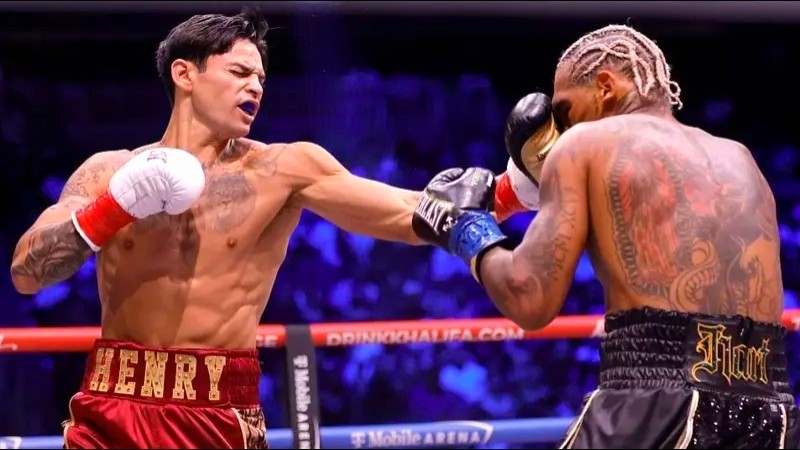
A minor bit of boxing news showed up on-line recently that was likely ignored by most fight fans. A card headlined by veteran William Joppy slated to go off this Friday in Binghamton, New York, was cancelled. The reason? Joppy’s opponent, one Emilio Cayetano, could not obtain the necessary work visa to get into the United States.
This information isn’t likely to generate any hysterics. Who knew that Joppy was still fighting, anyway? But this is not the first time that a fight in America has had to be cancelled because one of the participants had visa problems. In fact, it has happened numerous times over the past several years. This trend is something that should not be dismissed, as it is a reflection of larger developments in post-September 11th America. And boxing, a sport that is so closely linked with the poor and struggling communities of the world, is directly impacted by these developments.
A more high-profile case occurred a little under a year ago. In October of 2006, Juan Manuel Marquez was set to face Jimrex Jaca as the headliner of a HBO pay-per-view show. But that bout had to be cancelled, again because of visa issues.
The details of this particular case are interesting. Jaca did receive the necessary visa, but could not get the necessary stamp to approve it at the American Embassy in Manila. Apparently he turned up at the embassy several times, but was turned away because they had so many other cases to work through. After several days of fretting, Golden Boy cancelled the fight.
Marquez would go on to fight Jaca a month later. But that’s not really the point. What is happening now is, time after time, fighters are finding it impossible to make the necessary arrangements to get into America. Examples of this problem abound:
A couple of weeks ago, a fight on Telefutura involving undefeated Mike Alvarado had to be scrapped when Alvarado’s opponent couldn’t get into the States.
Earlier this year Jorge Solis was unable to attend a press conference to promote his fight against Manny Pacquiao because he couldn’t get a visa on time.
In 2006, IBF minimumweight champion Muhammad Rachman had to postpone a fight against Omar Soto, which was set to happen in Atlantic City. The fight did happen a few months later: in Rachman’s native Indonesia, not in the States.
In June, 2006, Pavel Miranda, set to face off against Timothy Bradley at a venue in Ontario, California, had to be replaced by Arturo Urena when he couldn’t get into the country.
A fight on June 15th of this year between fringe prospect Johnny Taunton and Mexican-born Oscar Marin was scrubbed when Marin was unable to get the proper documentation.
Such incidents, seen within the bubble of professional boxing, may seem unusual, but not much more than that. They are, however, emblematic of the troubles being faced by so many people now attempting to legitimately enter the United States.
Journalist and editor of Newsweek International wrote a column about this problem in the magazine’s February 26, 2007 issue. “The visa process [in America] is now so cumbersome that many foreigners have simply stopped trying,” he states. “The result is an extremely expensive system that…wastes resources and is making the United States a place people try to avoid.”
Zakaria goes on to quantify the problem. “Discover America, a group set up by the tourism industry to encourage travel to America, polled 2,000 randomly selected international travelers this winter and asked them ’which one location on the map is the worst’ in terms of visa hassles and nasty immigration officials,” he writes. “The United States topped the list by far.” The result? “Total international arrivals into the United States declined 10 percent between 2000 and 2004,” he tells us.
All of this, of course, is being done in the name of “security”. Right now America has two big bogeymen with which to stir up paranoia: Islamic terrorists, and illegal Mexican immigrants. Is it any wonder, then, that in all the examples of fighters experiencing visa problems listed above, every one of them involves an individual from either Mexico or a Muslim country (the Philippines isn’t a Muslim country officially, but it does have a significant Muslim population, and is a place that U.S. terrorism “experts” watch closely).
Of further interest is the fact that of all the examples given, only those which involved big-name fighters and big-time promoters were resolved. Solis made it to the States to fight Pacquiao, even though he couldn’t promote the bout initially. Jaca got his issues worked out and fought Marquez. In most of the other cases, another opponent was found, but the original participant lost his chance to take part in the fight, not to mention that the compensation that would go along with that. And most of these fighters were journeymen who would likely have appreciated the payday.
What this aspect of this issue proves is that money talks, and with the right clout the tangled web of bureaucracy necessary to secure a visa can be cut through if one has the power to do so. This may be swell for men like Oscar De La Hoya, as well as the fighters he represents, but it is another sign that the system itself is broken. Americans and their friends shouldn’t have to call in favours to get the government to work for them like they were living in some Third-World country. Moreover, only a certain fraction of the population has the abilities to access such methods.
Some of the more hawkish of you out there might dismiss all this as the “price to pay” in a world of international terrorism. But, as far as I know, no members of al-Qaeda or any other terrorist group have been nabbed because of these excessively complicated visa application procedures. Instead, a lot of honest, regular people have been turned away from a country that they wished to visit or work in. Such foolishness only breeds resentment. Surely this can’t be lessening the rancour of the extremist views; likely, it is recruiting more people to their causes.
Also, the long-term economic consequences of such isolationism are troubling. On this point, Zakaria states that “conferences in several industries and academic specialties are being moved out of the United States because of the hassle and humiliation factor.” Big-time fights likely won’t follow anytime soon, but a lot of smaller cards have already had to be cancelled, which have damaging effects for the local economies in the areas in which they were to be staged. Surely the people of Binghamton, New York, would have appreciated the money that would have come in had the Joppy fight happened as planned.
Boxers often grow up in conditions the rest of us can’t even fathom. The fact that they can use the sport to improve things for themselves and their families should be encouraged, as it should for those who do the same via other means; their lives should not be that much more difficult by red tape bred by ignorance and intolerance.