In beating fading countryman Tomasz Adamek in Krakow in late 2014, Artur Szpilka had asserted himself as the preeminent Polish heavyweight?
Saturday at nightfall, red and white began to appear on the Brooklyn roads that lead to the Barclays Center, and on the subway cars that meet below them. The colors concentrated on the arena?s front plaza, where parties posed for photos and smoked cigarettes, and at the restaurants and stands in its halls. Around the inner bowl, they were not so much a sea as boats in a harbor on a warm, windy day.
Most of the bearers spoke to each other in their native tongue. They had come here from Greenpoint and Ridgewood, and from enclaves in New Jersey and Connecticut. Home was further afield: a nation many of them had likely left in the 1990s and early 2000s among a wave of tens of thousands set free via the fall of communism and welcomed into the U.S. via a loosening of borders.
In numbers, they paled against the millions of Poles who had arrived a century before to work in fields and factories and mines, but their spirit was akin. In And My Children Did Not Know Me, John Bukowczyk writes of the first wave of Polish immigrants to the U.S.: ?Through it all, they would remain Poles, would become?in a sense?more consciously Polish as they banded together.? By virtue of White America?s absorption of first wave descendants, the gathering at Barclays was a cultural reprise of sorts, a new conscientious communalism that centered, paradoxically, on a most individual pursuit.
The pursuant was Artur Szpilka, the fighter who had been chosen as challenger in American champion Deontay Wilder?s third defense of his heavyweight title. A beefy, broad-faced Pole of 26 years, Szpilka sports a growing body of tattoo art and a round bare head that seems built to echo his surname: ?Pin.? Early in his career, Szpilka proved to be a tough and willful fighter, and in beating fading countryman Tomasz Adamek in Krakow in late 2014, had asserted himself as the preeminent Polish heavyweight.
Szpilka does not have a hero?s profile. He is a reformed hooligan of the notorious Wisla Krakow soccer team and an ex-convict of 18 months. Some Poles dismiss him as loudmouthed and crude, as an embodiment of waning stereotypes. In an interview on Showtime in December, he did little to dissuade this impression. ?This is no fucking joke,? he told commentator Steve Farhood about the upcoming fight. ?I?m going to kick his ass.? He turned to the camera. ?Remember, champ. I?m gonna kick your ass!?
In other eyes, Szpilka is a happy-go-lucky spirit who happens to be rough around the edges. His trainer, Ronnie Shields, describes him as ?a big kid trapped in a young adult?s body.? His Facebook page is full of playful videos: his girlfriend Kamila sleeping next to their dog; him back-flipping into a swimming pool.
Most importantly, Szpilka is Polish, and he fights hard in the name of Poland; for many, this is enough. As Szpilka entered the ring late that Saturday night, the music played for Polska, and Polska expressed their colors in sound, sending down a roar that was louder than their numbers ought to have made feasible. Szpilka wore a red bandana across his face: below the letters ?P.D.W.??which stands for ?greetings to prison??it portrayed a White Eagle, the national symbol of Poland.
The champion?the one who Showtime was selling to its U.S. audience that night?cut an imposing figure as he took his turn entering the ring. His entrance music: a song about Deontay Wilder.
*****
Just days after the fight, it is difficult to recall any thrown punch other than the linear right cross with which Wilder left Szpilka immobilized on the fringe of the canvas at the end of round nine. From the far side of the arena, the landed punch was indecipherable from Szpilka?s own momentum, which had begun with a lunching, looping left cross of his own and appeared to merely carry him forward and twist him over onto his back?just another acrobatic stunt. Only when Szpilka lay still was it clear that he was unconscious, and then his face appeared on the big screen as a picture of serenity. Only after that beat did the decibels rise, the thrill of the smaller Wilder contingent melding with the outcry from Polska.
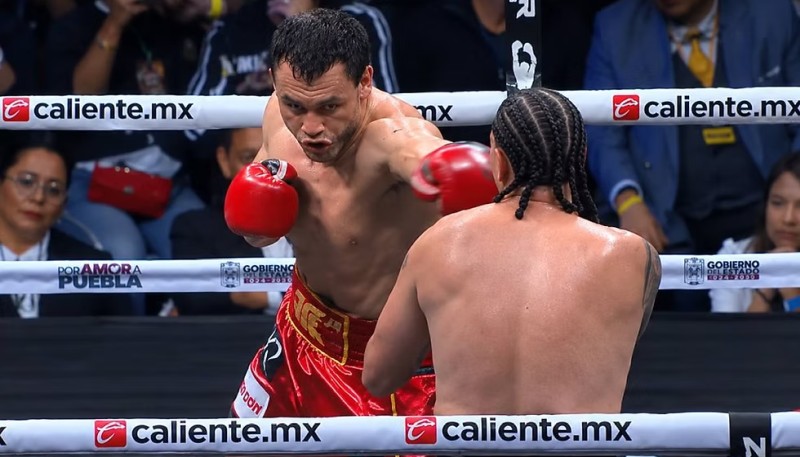
The record will show that Wilder had been up through eight rounds. In reality, Szpilka had more or less been running even with the champ?not ?kicking his ass,? but controlling the pace and in some rounds landing the more telling punches. Szpilka fought with patience but with authority, and his reflexes and footwork were sharp. He rarely let Wilder land a flush punch; often the bigger man was off target by a measure of feet. Most of all, Szpilka fought as though every moment mattered, while Wilder at times fought lackadaisically, as though to have to show urgency was in itself an admission of defeat.
As Szpilka continued to hold his own, the whoops that Polska let out at each auspicious moment began to become slightly guarded, as though they were hesitant to commit to the idea that Szpilka might, against all odds, win. The trepidation proved reasonable. Szpilka?s reflexes began to slide in round seven, and Wilder landed a couple of solid punches apiece in that and the eighth. Szpilka shook them off with bravado, but they were not too different from ones the Pole had eluded in earlier stages. Likewise, if in round one, Szpilka had advanced as Wilder was pawing the jab, it is conceivable that Szpilka would have had the wits to appraise that his foe was measuring his right, and then paused. In round nine, he lunged. The right was there to greet him, and that was that.
Wilder, who had professed a desire to hurt Szpilka in his pre-fight theatrics, was gracious and complimentary in victory. No more than two minutes later, though, he was making similar threats to oversized, overactive British champion Tyson Fury, who had crashed into the ring and begun his own display. The charade was performed to a thinning audience, whose boos and hoots seemed comparatively subdued. Most of the Polish faithful were already filing out of the arena.
I stopped one exit-bound, red-and-white clad couple to congratulate their man on his performance. ?He could win!? the man said. ?He could win! Just one punch! That?s boxing!? ?We?re proud of him anyway!? the woman added. I repeated the consolation to another passerby, who just smiled at me wistfully and put a firm hand on my shoulder before turning through the exit.
In the halls, one of the remaining contingents bounded for the street with a boisterous song from the pitch, sung to the tune of ?Guantanamera.? ?Nic sie nie stalo! Polacy, nic sie nie stalo!?
?No harm done!? It means, more or less. ?Poles, no harm done!?
*****
In the preface to his book, Bukowczyk writes: ?Individual freedom has proven a difficult thing to bear. The free individual can become a purposeless and lonely creature, prey to anomie and anger, anxiety and frustration.? Needless to say, ethnic cohesion has its own dark stories of tribal anger and anxiety, among immigrant communities in the U.S. and among those they join. Nonetheless, even for us descendants of immigrants who eschew tribalism?and those who indeed come to boxing for its raw individualism and self-expression?there is appeal, perhaps even a mild envy, in watching those bound by heritage unite in the irrational pride of cheering a compatriot on a field of play. A sort of meta-vicariousness defines the affair: living through the eyes of those who live through the eyes of their heroes. Even the sharing of a defeat has its own allure.
Bukowczyk warns not to romanticize ethnicity, that it is ?not only a matter of culture to these people, but of power and powerlessness.? This is a valid concern. Yet there seems to be a counterpoint in the reverberation of several thousand voices, and in the red and white colors.
Very early on Sunday morning, Szpilka posted to his Facebook page a photo of himself on his hospital bed. He is in a neck brace and has a tube affixed to his nose. He is extending his thumb upward through the blue sheet over him, and he appears to be making an effort to smile, though it is hard to be sure, as his eyes seem to express ache. Kamila is kissing him on top of his head, her own eyes downcast. His accompanying message translates to ?I?m okay! Sorry to disappoint you, and thank you very much for your support.? As of Tuesday evening, it had over 275,000 likes and over 11,000 shares.
A video taken by Kamila in the proceeding hours shows Szpilka?s return to his hotel, where Shields and others from his team greet him. His brace is gone, but he is still in his blue hospital clothes, and the redness and swelling on his temple and cheeks has worsened. ?What did I tell you,? he tells Shields. ?I give you 100 percent. But this??here he points to his own chin??I don?t remember nothing.? Szpilka shows good humor, and soon he has them all laughing, but his tone remains somber, even apologetic. ?Your fucking fans are incredible,? says Danny Arnold, his conditioning coach. ?I know, I know,? Szpilka says. Then he points to the bruises and chuckles without mirth. ?Look at my face.?
At the end of the video, Shields says to him, ?You?re the champ, champ.? Szpilka responds: ?I will be.?