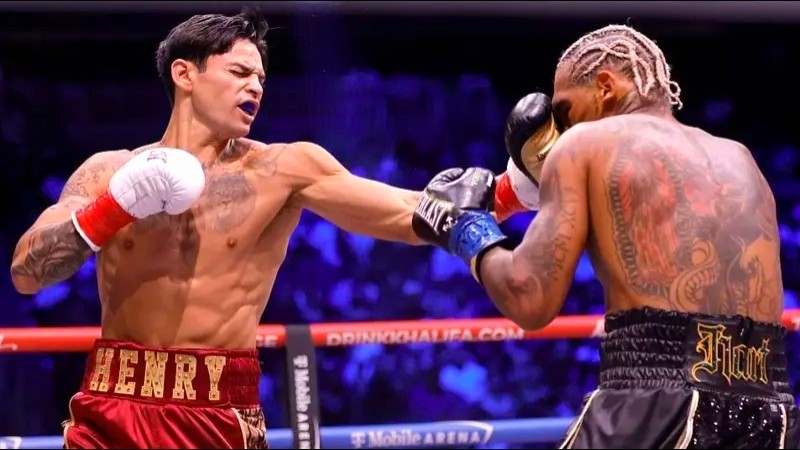
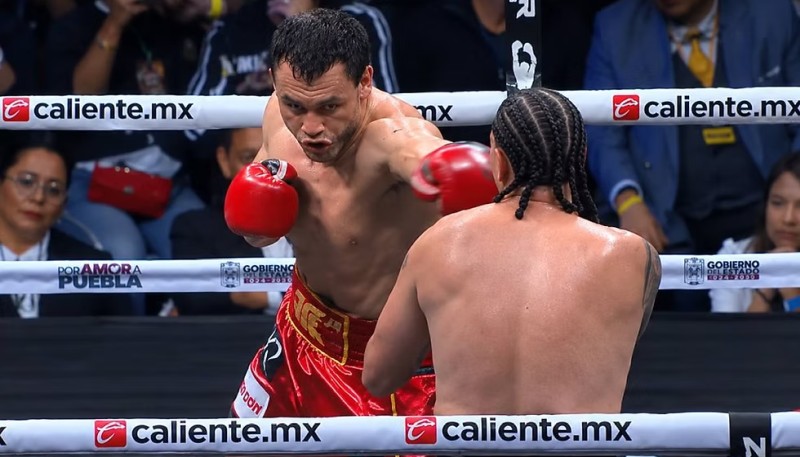
Leo Santa Cruz outpointed Abner Mares over twelve spirited rounds at Staples Center in Los Angeles last night, giving the 13,109 in attendance a reason to keep their ticket stubs. Because Santa Cruz-Mares, for now, is a fight worthy of a little memento, one people will remember fondly at least until the year is through, and the internet is overrun with articles bestowing unsolicited awards on fighters ever unaware that they have won them.
Just how good a fight Santa Cruz and Mares put on is, like too many things in boxing, subjective, which means the debates (should they happen) and arguments (you can bank on those) about its merits will rage with a passion reflective of how much people enjoyed the fight. And judging by not only the size of the crowd but its decibels, that enjoyment was immense. This is what happens when you do the obvious, like put turf wars between LA-based fighters in Los Angeles (for an example of what not to do, see the ?Battle for Ohio? that was fought in Las Vegas earlier this year).
The quality of the fight will also be lobbied for by apologists and enthusiasts of the PBC. For those who defend Al Haymon?s brand, Santa Cruz-Mares is proof that Haymon will not only match his stable tough but with entertainment in mind. That constituency will direct attention toward the opening rounds, in particular, when Mares, 125 1/4, bore into Santa Cruz and began the fight in a fever pitch. There was some concern that Mares, who had appeared tentative since being deboned by Jhonny Gonzalez in August of 2013, would be unable to recapture the competitive fire that helped power him through two divisions. Those concerns were snuffed out with the opening bell, as Mares dove in with hard punches, crowding his taller, longer opponent, before smothering any return fire. And Mares did not stop working once inside: Montell Griffin would appreciate the way Mares shouldered Santa Cruz? chin up and into the path of right hands.
It was an effective strategy, this intimate churning, but one that seemed impossible to maintain for twelve rounds. While Mares, born in Guadalajara, Mexico, but now living in Montebello, California, had early success in determining where and how the fight was being fought, he was not hurting Santa Cruz, and the question of who was paying more for that success, the fighter enduring it or the fighter taxed in delivering it, seemed worth asking. Even though Mares carried the first three rounds, the time between his rushes grew longer as Santa Cruz parsed these bursts and blunted them with long jabs and crosses.
Those looking to criticize the fight either in and of itself or because of the outfit that produced it (and there is no shortage of critics in a sport that boasts so many experts), will point to the rounds that followed the first three; rounds that became increasingly one-sided despite both fighters? struggles to seriously hurt the other. And this is a fair criticism in the face of the hyperbole, the corpses of all those victims of the moment. But why the fight took a turn away from the dramatic speaks to Santa Cruz, Huetamo, Mexico via Rosemead, California, being a better fighter than the one who slogged uninspired through all those recent shams. Instead of backing up when Mares attacked, Santa Cruz started slipping to his right, turning Mares and ripping into him. This slight movement lured Mares into a range he could neither score nor hold from but gave Santa Cruz room enough to work his entire arsenal. Trapped in no man?s land and forced to reset, Mares would either withdraw harmlessly or be driven back by the straight punches Santa Cruz pumped in his face.
Santa Cruz, 125, also outworked a tiring Mares on the inside, the full extent of his comfort evident in the jab-uppercut combination ?El Terremoto? added to his attack in the later rounds. Mares was game throughout, and if his fitness and daring are any indication, motivated like he has not been since his first loss; nevertheless, he was beaten by the better fighter, one who put forth a career-best effort against a career best opponent. Santa Cruz was awarded the victory by scores of 117-111 twice, with a third card scoring the fight a draw, 114-114.
One hopes those plotting the future of Santa Cruz do not overlook or take for coincidence the relationship between quality of performance and quality of opponent. Nor should they ignore the vitriol Santa Cruz and fellow Haymon clients have suffered for participating in mismatches. Santa Cruz, 31-0-1 (17), proved if nothing else, that while he may have fought down to the level of his opposition of late, he can fight up as well; and that, for all the hatred directed at him, people will support him if he is in compelling fights. Given the inactivity that plagues modern fighters, boxing is a sport concerned with brief, almost immediate history; and with social media providing so much grist for the mill, goodwill and momentum can be lost as much through the boredom of aficionados as through inactivity or desultory matchmaking. But with Gary Russell Jr., Carl Frampton, Jesus Cuellar, even recent Russell victim and former Mares conqueror, Jhonny Gonzalez available, the PBC would be wise to not let Santa Cruz squander again what so many fighters dream of having.
Absent from that list of future opponents is Mares, who at 29, and with years of grueling fights behind him, would be solved with greater ease in a rematch. What Mares, 29-2-1 (15), has left, especially at featherweight, where he is undersized and short on power, is hard to say: is he no longer a top-tier fighter, or is Santa Cruz good enough to make even the best competition look outmatched? That is something the futures of both men will reveal.