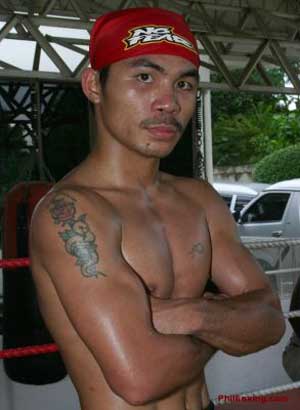
On January 20th, the day before Erik Morales and Manny Pacquiao wage war again, ESPN’s Friday Night Fights series makes its 2006 debut. The main event features a fight for the vacant IBF featherweight title between veteran Phafrakorb Rakkiatgym and relative newcomer Valdemir Pereira. This won’t overshadow the big fight on Saturday, but the two bouts are linked by events from the recent past. On October 26th, 2002, Rakkiatgym, as the mandatory challenger for the IBF super-featherweight title, squared off against then-champion Pacquiao. What followed was one of the more gruesome displays in a major fight in recent years.
A confident Rakkiatgym was predicting a knockout victory ahead of time. But a little over a minute into the match, Pacquiao had Rakkiatgym down on his knees with a vicious right hook. Pacquiao scored three more knockdowns in the first round before referee Bruce MacTavish mercifully ended the match as Rakkiatgym laid motionless on the canvas. Rakkiatgym was subsequently rushed to the hospital, and Pacquiao’s reputation as a heavy-hitting phenom was further cemented.
Back then, it seemed to many observers that Pacquiao could do no wrong. It’s easy to forget now, after the draw with Juan Manuel Marquez, after the loss to Morales, with so many questioning him, with so much on the line on January 21st. But as he was tearing through the opposition in those days, with every win coming in brutal fashion, with so much success at such a young age, with his superstar status in his native Philippines, it was easy to imagine that nothing but runaway success awaited him the future.
Pacquiao’s American debut a year before the Rakkiatgym fight is the stuff of legend. At that time he had been clinging to a minor super bantamweight title, demolishing all challengers in venues in and around Manila, the capital of his home country. South African Lehlohonolo Ledwaba, the IBF champion in the same division, had been tearing up the competition for some time, and was seemingly poised to make his own run at glory. On June 23rd, 2001, Ledwaba was supposed to make a relatively easy mandatory defence of his title against Enrique Sanchez. However, two weeks before the fight, Sanchez pulled out with an injury, and the IBF settled on Pacquiao as an appropriate substitute.
Pacquiao trained for the match at Freddie Roach’s Wild Card Gym, and word spread quickly about the beatings he was administering to his sparring partners there. Still, fans in America didn’t quite now what to expect from the young fighter, and Ledwaba went in as the favourite. Perhaps Ledwaba and his promotional team did not think all that much of Pacquiao. Perhaps they did not realize that, only two months earlier, he had scored an impressive victory over tough Thai contender Wethya Sakmuangklang, or that he had been keeping himself in fighting shape since then. Certainly they didn’t expect what was coming.
Late in the first round, Pacquiao set the tone for the match with several vicious combinations that landed flush and bloodied Ledwaba’s nose. Early in the second, he drilled Ledwaba again with shots to the head and sent him to the canvas for the first time. By the end of the round, Pacquiao had the crowd on its feet with a hard left that sent the champion reeling once more. By the third round, Ledwaba’s trunks and gloves were covered in a thick coating of his own blood. A shot at the end of the fifth sent him staggering back to his stool, seemingly semi-conscious. After two more vicious knockdowns in the sixth, the fight was mercifully ended by referee Joe Cortez, as Ledwaba writhed on the canvas in agony. On a night when Oscar De La Hoya gave a pedestrian effort in a win over a pedestrian opponent (Spanish fighter Javier Castillejo), Pacquiao stole the show.
The next few years were good for Pacquiao. He hooked up with trainer Roach fulltime, and bounced between America and the Philippines, dispatching virtually all comers with the same electrifying power he showed against Ledwaba. His fan base multiplied with every brutal combination, every sensational knockout blow. His two round disposal of Jorge Eliecer Julio was featured on the Lennox Lewis – Mike Tyson undercard. His one-punch KO of Emmanuel Lucero in July 2003 via what was becoming his patented straight left outshone Fernando Vargas’s lacklustre comeback performance in the main event. Manila mayor Lito Atienza went so far as to declare June 9th to be “Manny Pacquiao Day” in his city. A mystery no more, Pacquiao was an internationally-recognized prodigy.
Then, of course, there was the Barrera fight. Pacquiao’s November 15, 2003 eleven-round demolition of the Mexican great is undoubtedly his greatest accomplishment so far. He delivered an almost-perfect performance that left the primarily pro-Barrera crowd at the Alamodome stunned. Barrera was in the running in the early going. But by the middle rounds, Pacquiao had taken over and was giving him a tremendous beating. When Barrera’s brother and cornerman Jorge stopped the one-sided affair late in the eleventh, Pacquiao’s place in boxing history was assured.
The Barrera fight, however, marked the end of this remarkably successful phase of Pacquiao’s career. After his draw with Marquez, the criticism began to rain down. Increasingly, a particularly stinging term was being used to describe his abilities: “one-dimensional.” After scoring three knockdowns in the first round of their May, 2004 bout, Pacquiao spent much of the rest of the night trying to deliver the left that would send his Marquez to the floor for good. But the slick Marquez stayed on his feet the rest of his way and put on a boxing clinic for his less-polished opponent.
Pacquiao later claimed that an injury had prevented him from throwing effective combinations. And many observers had thought that he won the fight anyway. Regardless, the loss to Morales less than a year later dispelled even more of the mystique surrounding Pacquiao. Suddenly, aspects of his game that were previously thought to be assets were looked at in a different light. That left hand, in particular, was beginning to look like something of a crutch. When it failed him, he had nothing else to offer. His unchecked aggression was becoming viewed as lack of a coherent strategy. He was, in short, a one-trick pony.
Reputation is a funny thing in boxing. A good one is lost just as quickly as it is earned. An impressive outing can create an aura around a fighter that is perhaps not wholly deserved. The fact is that Pacquiao has always been something of a flawed fighter. What he lacks in other areas he makes up for with devastating power. This means he matches up well against some styles and badly against others. What has changed primarily over the past year is the perception of Pacquiao among boxing fans, not his abilities.
But Pacquiao has been down this road before. Years before his splashy arrival in America, he had already won and lost a world title in the flyweight division. But he regrouped and made adjustments, moving up three divisions to a weight that he was more comfortable with, and began the run that would lead him to the super-bantamweight crown. Now, further tweaking is necessary for Pacquiao to flourish once again.
Under Roach, he has been working to become a more complete fighter, developing his footwork, his head movement, and his defence. His new skills will need to be used to their utmost in order to triumph over Morales, who quickly adjusted to Pacquiao’s style the first time around. But a win will give Pacquiao new life. He will never again be surrounded with the same aura of invincibility that he once had. But that was always an inauthentic image. He has the chance now to craft a more genuine, more credible reputation.
Much is on the line for Pacquiao on Saturday. The fight with Morales will play a large part in determining the direction that the next stage of his career will take. While a win gives him a fresh start, a loss could mark the beginning of a long decline. If he needs reminding of that, he can just ask Ledwaba, or Rakkiatgym, or any of the other contenders he dispatched with such ease at the start of his glory years.