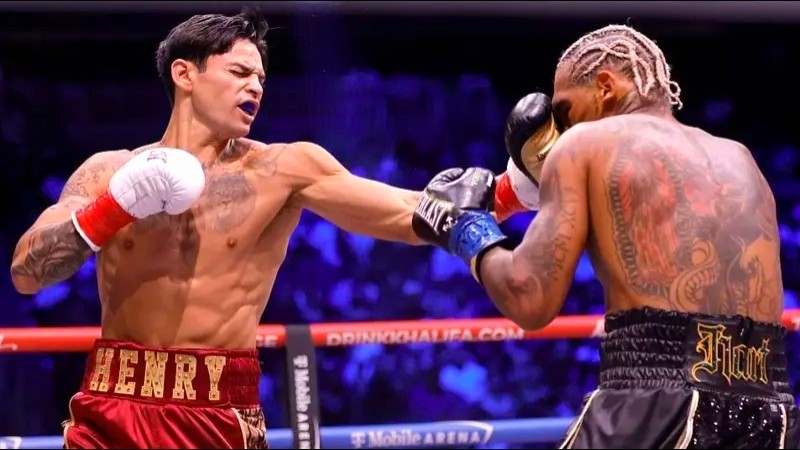
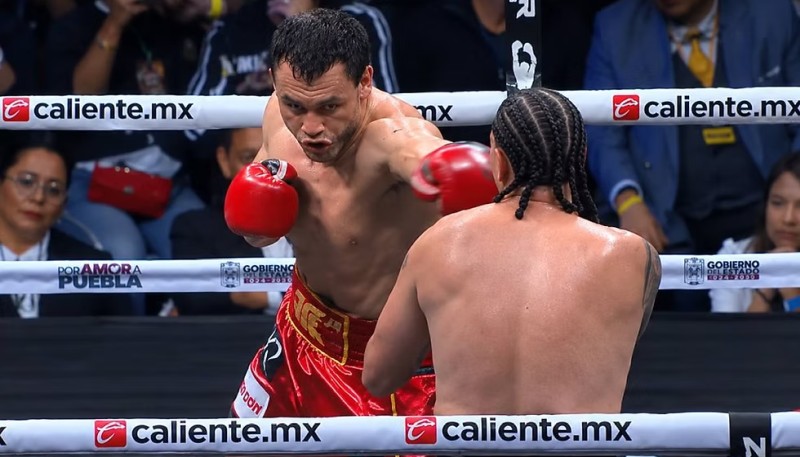
Young prospects Rey Bautista and Jorge Paez Jr. ended the year like two speeding bullets headed to the future.
Paez, Bautista and a small emerging group of other young pugilists 21 years old and younger represent a new generation of fighters in the Southern California area ready to fill the spaces left by Oscar De La Hoya, Sugar Shane Mosley and Fernando Vargas when they eventually retire.
Though all three elite prizefighters still have some years left should they desire, some of these barely legal prizefighters may attain the same level as the Golden Boy, Sugar Shane or El Feroz. Let’s take a look into the future of boxing.
Just last week, boxing fans got a glimpse of Paez and Bautista on the same fight card, one that was also televised.
Bautista, 19, though originally from the Philippines, makes Southern California his base of operations and is trained by Freddie Roach.
“He’s a tough-minded kid,” said Roach, after watching his charge suffer a second round knockdown against Gerardo Espinoza then forge ahead with pure grit. “He showed me a lot in coming back like that.”
The thin-framed Bautista, with a dainty-looking face that might be a tempting target for the roughhouse fighters in the bantamweight division, showed a seek-and-destroy style reminiscent of Felix Trinidad. He just keeps moving forward with his guard high.
The eyes say it all.
“He doesn’t quit,” Roach said.
On the same card last week, Paez fought a furious lightweight bout against Lee De Leon before connecting with a double left hook that dropped the taller fighter in the second round of a scheduled four-round contest.
The son of Jorge “Maromero” Paez wields speed and power on both hands, but drops both gloves when firing combinations. At 18, he still has time to rid himself of those bad habits.
Like his dad, he grew up in Mexicali, but fights under the nickname “El Raton.” Already, he has a growing number of fans that flock to see him.
“Paez looks pretty good,” said Paul Hernandez, a boxing writer for Punch News. “He looks more advanced than Julio Cesar Chavez Jr.”
Paez had more than 100 amateur fights before turning professional.
Amateur factory Hundreds of young boxers pass through lengthy amateur boxing programs, gathering experience, some beginning at the age of five. A lucky few advance to international competition, including the Olympic team, every four years.
Even fewer win medals in the worldwide competitions that lead to lucrative contracts with promoters.
But nothing is certain, even for Olympic medal winners.
Jerry Pavich from Hesperia, California had an admirable amateur career and always seemed suited for the pro level with his aggressive style. He’s only had one fight, but should make some waves in the flyweight level.
Another is Jonathan Velardez, 17, from San Bernardino, who has a knockout victory in his only pro fight. He’s the younger brother of Bobby Boy, Armando, Chris and Alex Velardez. As an amateur he won numerous national titles with his quirky but effective southpaw style.
“Jon Jon is not afraid of anything,” said Armando Velardez, his father and trainer. “He’s been fighting since he could walk.”
Tired of the politics of the amateur programs, Velardez opted to turn professional and fought in Tijuana, Mexico, where the age limit is lower than that of the U.S. He won by first round knockout.
In the junior featherweight division, Abner Mares has been catching the eyes of opponents, matchmakers, promoters and fans nationwide.
Mares, a former representative of the 2004 Mexican Olympic team, entered the pro ranks with a two-fisted destroy or be destroyed style that saw him take as many shots as he gave. He won by his superior strength. Then Floyd Mayweather Sr. began training the Hawaiian Gardens resident and to the surprise of many, he easily adapted the defensive nuances and counter-measures.
“He’s an aggressive little slugger,” said Doug Fischer, editor of Maxboxing.com.
Others feel Mares made quantum leaps in mere months.
“Mayweather did a hell of a job with Mares,” said Derek Smith from Uppercut Magazine.
In his last fight, Mares was trained by former flyweight world champion Joey Olivo.
Trio of terror in the junior lightweights Three young junior lightweights named Jose Lopez, Brandon Rios and Dominic Salcido are tearing up the landscape with their quick fists and knockout power.
Lopez, 21, from Riverside, has been fighting more than the other two, and has become a featured main event fighter at the Doubletree Hotel under Thompson Boxing Promotions.
“Jose is getting better every fight,” said Henry Ramirez, who helps train Lopez along with Andy Suarez.
Lopez (15-1, 9 KOs) has strung up 13 consecutive victories, including wins over veterans Jose Luis Tula, Allen Litzau and Ulises Pena.
Rios (8-0, 6 KOs), 19, trains in Oxnard, and in two years has eight fights and six knockout victories.
“He has a lot of natural ability and no shortage of power,” said Fischer. “He’s a lot of fun to watch.”
Another fighter fun to watch is Salcido, 21, who lives in Rialto. The smooth boxer-puncher has a style resembling Pomona’s Mosley, a quick darting cobra-like attack that stirs fan reaction whenever he fights.
“I’m trying to keep him busy,” said Emanuel Steward, his manager, who formerly managed Tommy “Hitman” Hearns.
Salcido’s (7-0, 4 KOs) biggest victory came against Rogelio Ramirez, a strong-chinned opponent who had upset Steward’s Michigan-based Octavio Lara. Ramirez was stopped in four rounds with a barrage of punches that left him bewildered.
Straight from the streets Not all pro boxers graduate from the amateur boxing programs. A few come straight from the streets of Los Angeles, Mexicali, or Oxnard.
Among lightweights, the name Hector Leyva (7-3, 4 KOs) is no longer one of boxing’s best-kept secrets. After upsetting Jose “The Punisher” Perez and David Rodela, the Los Angeles-based fighter by way of Mexico has become a feared 135-pounder despite having two losses on his ledger. He has no amateur background.
“I love that guy,” said Brad Goodman, a matchmaker. “He’s such a tough kid.”
Victor Ortiz (10-1, 6 KOs) is another fighter serving notice in the lightweight division. The Oxnard-based fighter is trained by Roberto Garcia and his father Eduardo Garcia and that usually means expert fundamentals.
“He should be undefeated but his opponent claimed he suffered a broken neck on a foul,” said Cameron Dunkin, manager of Ortiz, 18, a southpaw. “Victor is fearless. He’ll fight anyone.”
Desert Storm Just one level up, in the junior welterweight division, Timothy “Desert Storm” Bradley out of Indio has his own blitzkrieg working the 140-pounders.
Bradley (10-0, 5 KOs) was fighting in the welterweight division despite having a size disadvantage almost every match. At 5-6, the quick-fisted and defensive expert uses his strength or speed to dissemble opponents bigger than himself, but seldom stronger.
“He learns quickly,” said Joel Diaz, his trainer, who also trains Julio Diaz, his younger brother. “Timothy uses his size to his advantage.”
Against Brazilian left-hander Andre Marcos Nascimento, the popular Bradley used every trick he knew to find a solution to his opponent’s size advantage. After five rounds of give and take, he finally cracked the Brazilian’s defense and knocked him out.
“This guy was the toughest guy I faced,” said Bradley, who in a little more than one year has 10 pro fights. “I’m learning.”
Vanes Vanes Martirosyan (6-0, 3 KOs) represented the U.S. Olympic boxing team in 2004 to the surprise of many throughout the country. Not in the Southern California area. In various amateur shows, the 6 foot 1 Martirosyan put on displays of power boxing in the junior middleweight amateur division on a monthly basis. Now he’s learning the craft of professional boxing.
“It’s hard to get rid of the stuff you learn as an amateur,” said Justin Fortune, a trainer at the Wild Card Boxing gym in Hollywood, where Martirosyan prepares. “He has the tools.”
Young boxing prospects such as Martirosyan, Bradley and the others may shine brightly under certain angles of light and slightly bent under others. In the end, it’s still difficult to tell who has the ability to win and become a gate attraction.
“You got to have that special something,” said Bennie Georgino, former manager and trainer of numerous world champions. “Fighters like that don’t grow on trees.”