For the past few years, the pound-for-pound ratings have been as fashionable as fighters filing for bankruptcy. Given the absurdity of the alphabets, ranking Bash Boulevard’s best in such a manner makes perfect sense. But why doesn’t anybody rank the best pound-for-pound divisions?
If there were such a listing today, there’d be little argument that the welterweights would stand at the top.
“Whenever the heavyweights go into an eclipse, the welterweights seem to heat up,” historian Bert Sugar said. “You have to like what they’re giving us and good fights beget more good fights — and more money.”
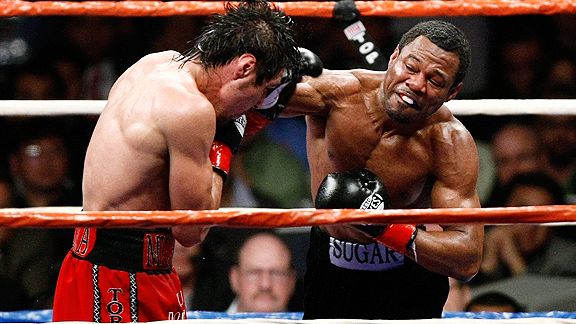
Shane Mosley’s surprise annihilation of Antonio Margarito was a vivid reminder of how much star power can be found at 147 pounds. Miguel Cotto still does his business here, as do Andre Berto, Kermit Cintron and Josh Clottey. But what separate the welters from the other divisions are the part-timers, including Paul Williams, Manny Pacquiao, Oscar De La Hoya, Ricky Hatton and Floyd Mayweather. All of those pound-for-pound stars have fought at welterweight sometime within the past 18 months.
And maybe some will return.
In the meantime, the abundance of talent can be blinding, so a bit of perspective is advised: This is a good time, but it’s not the golden age of the welterweights, nor is it a golden age.
At least not yet. In fact, in terms of what really matters — great fighters, big fights and thrilling moments — this crop of welters doesn’t compare to the remarkable vintage from a decade ago, or from 20 years before that, when a six-pack of hall of famers engaged in a round-robin that rendered the heavyweights even more irrelevant than they are today.
In the late ’70s and early ’80s, the 147-pound headliners were as compelling as imaginable. From January 1979 to September 1981, Sugar Ray Leonard, Thomas Hearns, Wilfred Benitez, Roberto Duran, Pipino Cuevas and Carlos Palomino engaged in seven bouts at welterweight (and over the course of 10 years, 12 bouts in all), with 10 of the possible 15 matchups ultimately realized.
“It was very unusual; most of the top fighters in the world were in the same division,” said Emanuel Steward, who managed and trained Hearns. “And they all fought each other.
“Ray was the driving force. The public fell in love with him, and there’s never been a fighter in history, including Ali, who controlled boxing like he did.”
It’s not an overstatement to say that Leonard-Duran I and II and Leonard-Hearns I were fights that stopped the world. Moreover, Leonard-Hearns I is an example of all-time greats clashing in their primes, and at their best weights. Try to think of other fights that meet that criteria. Your list will be a short one.
“I’ve covered nearly 400 world title bouts since,” George Kimball wrote in “Four Kings,” “but with all its fascinating nuances, Hearns-Leonard I remains the best fight I was ever privileged to watch.”
Fast-forward almost 20 years: At the beginning of 2000, three of the top five fighters in the pound-for-pound rankings, De La Hoya, Mosley and Tito Trinidad, were welterweights. A year or two before that, Pernell Whitaker and Ike Quartey were also in a magical mix. From April 1997 to June 2000, these 147-pounders produced five superfights, with either Trinidad or De La Hoya participating in all of them.
“For pure talent, these fighters had maybe as much as the Leonard-Hearns-Duran group,” said promoter Lou DiBella, who was making fights at HBO during the late ’90s. “Oscar’s best weight class was 147. Quartey was a beast. Even at the tail end, Whitaker still gave Oscar fits. Mosley was brilliant. And the pre-Hopkins Trinidad had everything — power, passion, excitement.
“The difference from these welterweights and the Leonard group is that they didn’t create any all-time rivalries. Still, it’s the best bunch since.”
It’s foolish, of course, to historically rank today’s welterweight division before the fights and fighters play themselves out. But if the current crop wants to join the Leonard-Hearns-Duran-Benitez and De La Hoya-Trinidad-Whitaker-Mosley powerhouses, certain things will have to fall in place.
Mayweather will have to come out of retirement and face Pacquiao at welterweight.
Williams, whose ability to gain and shed pounds presumably makes him the envy of his peers, must engage in at least one or two additional major matches at 147.
Berto will have to establish himself as a pound-for-pound entrant by defeating Mosley, Cotto or one of the division’s other established stars.
Mosley will have to stick around awhile longer.
Until all or some of that happens, let’s enjoy the welterweight division for what it is, but not laud it for what it hasn’t yet become.