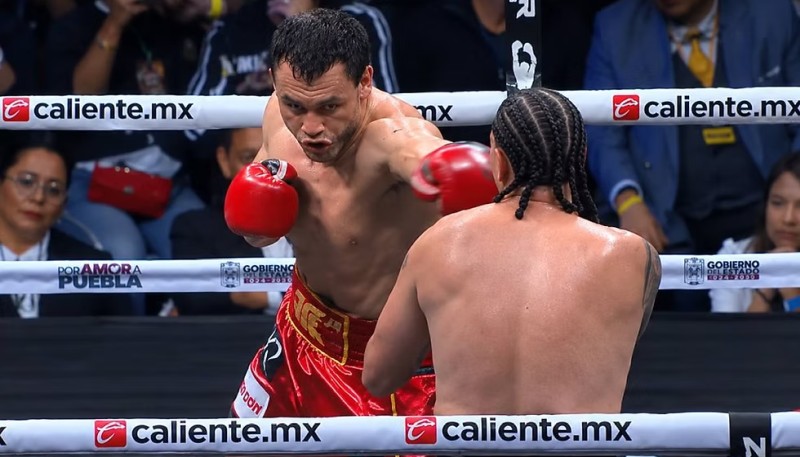
For all of the pageantry and star power associated with Saturday’s Canelo Alvarez-Julio Cesar Chavez Jr. fight — arguably the biggest in the great history of Mexican boxing — there’s an unspoken question that keeps getting overlooked.
We know that Alvarez (48-1-1, 34 KOs), the sport’s reigning pay-per-view king, is the more skilled fighter and unquestionably the clear betting favorite heading into their Las Vegas showdown at T-Mobile Arena (HBO PPV, 9 p.m. ET).
We also know much of that can be associated with how successful Chavez (50-2-1, 32 KOs) has been at throwing away his own career over the last five years with drug suspensions, a constant inability to make weight and an overall lethargy towards training and professionalism.
But considering this fight could very well double as Chavez’s final shot to prove he can still compete (and just as importantly sell PPVs) on the elite level, what happens if we end up seeing the best version of him on Saturday that has ever stepped inside of a ring?
For as simple as the question is, very few have pondered it openly, mostly because it has been so long since we have seen Chavez, 31, anywhere close to his prime.
Chavez has undoubtedly been his own worst enemy when it comes to his career derailment. But to understand how dramatically his chances in the fight might change should he be at his most fit and focused on Saturday, we need to go backwards to look how it all went wrong.
The son of the Mexican legend with the same name certainly wasn’t as skilled as his famous father during his 15-month run as a middleweight titleholder beginning in 2011. But he possessed a trio of intangibles that simply couldn’t be taught: an almost predestined ability to attack the body, a granite chin and absurd ability to rehydrate upwards of 20 pounds after weighing in.
It’s because of the latter that Chavez often looked one-to-two weight classes larger than his opponents, which perfectly complimented his aggressive infighting. And Chavez relied on all three intangibles mentioned to rally back in Round 12 to drop (and narrowly miss knocking out) Sergio Martinez in their dramatic 2012 bout despite badly losing the first 11 rounds.
In hindsight, all was not well during camp ahead of the Martinez fight, which saw Chavez suspended for nine months in the aftermath for a failed drug test for marijuana. HBO 24/7 cameras documented a lazy Chavez who slept all day and, quite literally, walked around his rented house in pink underwear eating cereal as his father attempted to give him advice.
Not only did Chavez mail in the training portion of the camp, he often refused to work out in a gym, forcing then-trainer Freddie Roach to come to his house, where furniture was rearranged in the living room to open up space to hit the pads. The story might as well have been a microcosm of Chavez’s next five years, which saw more trouble and less discipline.
“The difference [then] is that I was younger and less experienced,” Chavez said during Monday’s teleconference. “Over the years, I’ve learned from those kind of mistakes and the inexperience that I had.”
The rock bottom moment came in April 2015 when Chavez accepted a fight against his father’s wishes at a catchweight of 172 pounds facing light heavyweight contender Andrzej Fonfara and quit on his stool moments after being knocked down for the first time in Round 9. Three months later, he looked disinterested in a victory over Marcos Reyes.
Chavez admits he considered quitting the sport for good in the aftermath.
“It may have crossed my mind at some point, obviously after the Fonfara fight and the Reyes fight, those were two fights where I don’t think that I had the same amount of passion that I needed to have,” Chavez said. “But this fight is a lot different. This fight has created a lot of passion in me, a lot of enthusiasm, and I think that that’s the difference in this.
“I think that you’re going to see a different Julio that’s excited.”
Simply saying his fighting spirit has returned and showing it are admittedly two different things. But if you’re looking for reasons to support the idea of Chavez having a good shot at pulling the upset on Saturday, you don’t have to look too far.
Chavez has employed the services of Hall of Fame trainer Nacho Beristain, mostly because he said it’s a voice in his corner he knows he has enough respect for. He also added successful (and sometimes controversial) strength coach Angel Guillermo “Memo” Heredia, who was responsible for transforming the body of Juan Manuel Marquez into a muscular, power-punching welterweight late in his career.
Even more, Chavez appeared to take training very seriously this time around, secluding himself for two months doing high elevation training in the Otomi Mountains outside of Temoaya, Mexico. The pictures and videos that came out of camp show Chavez in phenomenal physical shape.
“The difference [this training camp] is I was listening to my corner, Mr. Beristain,” Chavez said. “He had me doing certain training and I did it. It was very difficult in the beginning getting used to this new regimen, but it’s something that I did. I followed it and I think that’s the difference in this fight.”