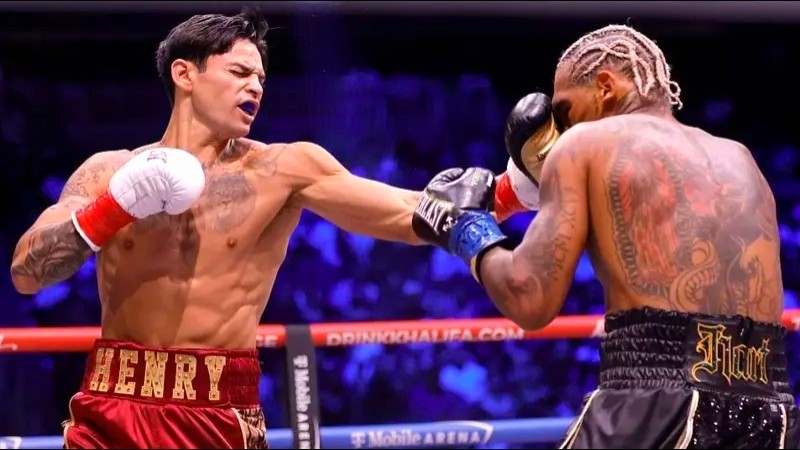
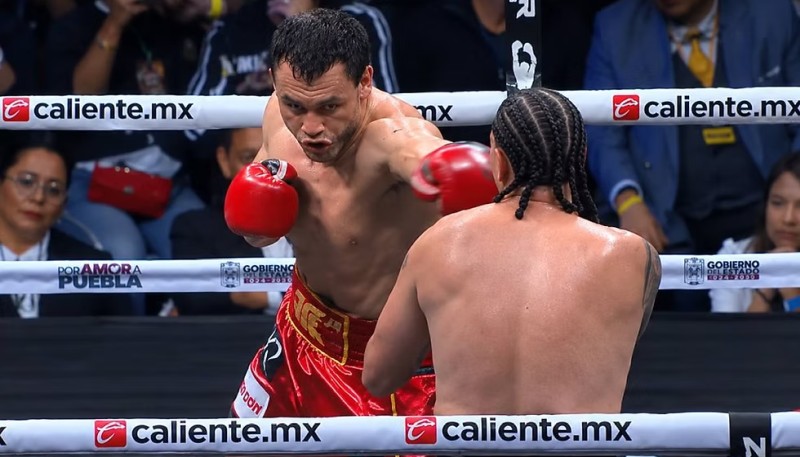
On November 15, 2003, Manny Pacquiao walked into the ring in San Antonio?s Alamodome a 4-to-1 underdog against legendary Mexican champion Marco Antonio Barrera. Few outside the Philippines had any idea who he was, but after eleven punishing rounds, the thousands in attendance and millions watching around the world understood a clear message: the PacMan was a force to be reckoned with, and was here to stay.
Forty-two months later, Pacquiao returned to the scene of his greatest triumph, but this time the circumstances were far different. This time he was the favorite, against an unknown underdog. When promoter Bob Arum announced Jorge Solis as Pacquiao?s opponent for his April 14 mega-card, even the most ardent followers of boxing scrambled to Google clamoring for information, if any even existed, on this undefeated fighter from Guadalajara, Mexico. The results were scant and scarce. His brother, Ulises Solis, is a champion in the light flyweight division; Jorge once fought Humberto Soto, but the fight was stopped in the third round and ruled a no contest due to an accidental head butt suffered by Solis.. Although he was ranked in the top ten in the super featherweight division, few even in boxing had any idea how he, of all people in this deep division, ended up with a shot at Manny Pacquiao.
Since his fight against Barrera, Pacquiao has stormed through two divisions with vicious authority. He knocked down Juan Manuel Marquez three times in the first round, only to have an inexplicable judging error rob him of victory. In an epic trilogy, he knocked out Erik Morales not once, but twice, essentially ending the legendary fighter?s career. Once thought of as a one-dimensional boxer, he has added ?Manila Ice? to his repertoire, a smooth right hook that complements his explosive left cross perfectly. His defense has shored up, and his conditioning is superior to anyone else in boxing. If not for Floyd Mayweather, he would certainly be regarded as the best boxer on planet Earth.
Coming into this fight, Pacquiao?s life outside of the ring, as usual, was surrounded by a variety of chaotic influences. Two promoters, Golden Boy Promotions and Top Rank, were in a legal struggle, each skirmishing desperately for Pacquiao?s promotional rights. His trainer, Freddie Roach, was in Puerto Rico training Oscar De La Hoya for his mega-bout against Floyd Mayweather. And, most interestingly, Pacquiao announced he was running for the Philippine Congress, representing his hometown of General Santos City. His fans advised against this, but a sincere Pacquiao states his reasoning is to simply help the poor people of his country; after all, as a young boy, he grew up on the streets, fighting for food and a place to live.
Just before the fight, Freddie Roach flew in to San Antonio to work Pacquiao?s corner. If Solis had any chance at all, it was now gone, as Pacquiao regained confidence under the gaze of the father-like presence of his coach. Solis entered the ring first, to Mariachi music and the roar of the mostly Hispanic crowd. Mexican flags glittered throughout the crowd, and Solis smiled widely, looking confident and strong. Pacquiao entered next, to one of his own songs (he is a hit singer in the Philippines). The reaction was mixed; the few Filipinos in the crowd cheered loudly, but those cheers were mostly drowned out by the boos of his detractors. His return to San Antonio was not exactly a welcoming one.
After introductions by Michael Buffer, the fight was on. Only there was not much of a fight for the first five rounds. Pacquiao, 44-3-2 (35), was content to do just enough to win each round, the equivalent of a car on cruise control. He landed here and there, and Solis, 32-1-2 (23), mostly looked awkward, with the stance of a penguin, landing an occasional jab but not much else. His champion brother urged him to jab more and take the fight to the champion, but this went in one ear and out the other, as Solis continued to plod around the ring as time flew by.
In the sixth round, the light bulb in Pacquiao?s head switched on. After a clash of heads, Pacquiao was cut over the left eye. This seemingly awoke the lackadaisical Pacquiao; Solis was in big trouble. After the ring doctor allowed the fight to continue, Pacquiao stormed immediately to Solis and unleashed rapid-fire combinations, putting him down on the canvas almost immediately. Referee Vik Drakulich called it a slip, but no matter. Pacquiao continued to hand out a brutal beating to Solis. Right hooks, left crosses, body shots. Solis received the full arsenal of weaponry from Pacquiao as the crowd marveled at Pacquiao?s grace and Solis?s courage.
In the seventh round, not much changed. Pacquiao continued to assault Solis all around the ring, and Solis held on for dear life. Roach urged his charge to finish off his opponent, and Solis?s corner was quickly running out of ideas; his thirty-six minutes of fame were running out. In the eighth round, Pacquiao put down Solis again–this time officially ruled a knockdown–with a short left hook. Solis did not look like he would get up, but he willed himself up at the count of nine. Perhaps this was not a wise decision, as a quick jab from Pacquiao set up a lethal left cross. The result was vivid and appalling at the same time–Solis fell like a redwood tree that had just been cut down. Drakulich gave him the formality of a count, but Solis could not make it up in time. The fight was over, Pacquiao had won again in San Antonio, and Jorge Solis was seeing stars.
The next fight of Manny Pacquiao?s career will not be in a boxing ring, and punches will not determine the result. The voters of General Santos City have the power in their hands, as they will decide if their beloved hero will overtake Darlene Custudio and her powerful family. After his stirring performance against Solis, he won not only a boxing match and retained a minor championship belt, but probably a few votes as well.
Notes from the Undercard
– Jorge Arce was the second-biggest star on the card after Pacquiao, but after this fight against Cristian Mijares, his rapid rise in the boxing world was put on hold. Mijares, 31-3-2 (12), the reigning Super Flyweight champion but like Jorge Solis a virtual unknown, completely outclassed Arce, 46-4-1 (35), in every minute of every round. Fluid combinations, one after another, opened up Arce?s nose to the extent that Mijares?s trunks, which were white at the beginning of the match, had transformed to a shade of red. Arce never stopped trying; he continued to ask Mijares to keep punching, but on this night he was simply in the ring with a boxer who had too wide a variety of skills.
– Coming into his fight against Anthony Shuler, Julio Cesar Chavez Jr. had his share of detractors and doubters. To be frank, he was living off the name of his renowned father. This fight was supposed to be his toughest test, but if Chavez was in school, he would have received an A+. After a nonchalant first round, Chavez, 31-0-1 (24), unleashed a straight right hand that sent Shuler, 20-5-1 (14), stumbling backwards to the canvas in the opening moments of the second round. Shuler made it up and did not look overly hurt, but a malicious Chavez left hook ended the fight instantly. So fierce was the punch, that Shuler was unconscious before his body hit the ground. The referee immediately called the fight off, and the crowd roared, surely for the kid in the ring, but more than likely as an appreciation for his father?s conquests over the years.
– Undoubtedly, the fight of the night was the first fight of the pay-per-view broadcast, which featured Brian ?The Hawaiian Punch? Viloria, against Edgar Sosa. Rarely does a fighter get three consecutive championship fights, but that was the case with Viloria. After being humiliated by Omar Nino, and then being robbed of a victory in a rematch, this was perhaps Viloria?s last chance at a title. Sosa, a Mexico City fighter with five losses on his record and no significant bouts to speak of previously, was as unknown as Jorge Solis in the main event. Viloria has never been the same after nearly killing Ruben Contreras in 2005, and it showed in the fight. Viloria had the better fundamental boxing skills, but throughout the fight, he was simply out-hustled. Sosa, 27-5 (14), pressured Viloria, 19-2 (12), constantly, landing inhumane combinations to the body and head. With each combination landed the crowd grew louder, screaming, whistling, and stomping to the point the arena felt as if it was shaking. By the time the twelfth round began, Viloria?s forehead was scarred by welts, damage resulting from the fury of Sosa. Sosa finished the fight strong, following Viloria around the ring and landing hard shots whenever Viloria stood stationary. The roar of the crowd was surreal, the type of moment that sends chills up one?s spine. In the end, though the scorecards were implausibly close, Sosa won the Light Flyweight championship, and Viloria must take a look in the mirror and reassess his career plans.