SAN DIEGO, April 30, 2015 ? Unless you live completely off the grid, which isn?t likely if you?re reading this, you?re aware there is a big stakes boxing event coming up on Saturday, May 2. It is the megafight between American boxer Floyd Mayweather and Filipino boxer Manny Pacquiao, taking place in Las Vegas at the MGM Grand Garden Arena and being shown in the U.S. on the premium cable networks Showtime and HBO.
This is a fight devoted fight freaks like yours truly have dreamed about for years. Mayweather (47-0-0, 26 KOs) and Pacquiao (57-5-2, 38 KOs) are such big names of the sport, even people who aren?t avid boxing fans are paying attention.
Those who love the ?Sweet Science? are thrilled with all the attention directed at boxing leading up to the fight. We recognize there are many people new to boxing, and we hope many of you will continue to watch after Saturday?s fight.
Like any sport, boxing has specific rules, terms, skill sets, and history. To help those new to the sport maximize your understanding and enjoyment of the event, Ringside Seat offers up our brief guide to boxing. Manny Pacquiao weighs in before his fight with Timothy Bradley Jr. in April 2014. Photo: Top Rank.
Weight Classes
Boxing is a combat sport between two individuals of the same gender, within a specific weight class. There are 17 different weight classes. Fighters must weigh-in the day before a bout, and be within the assigned weight class range. Floyd Mayweather and Manny Pacquiao are welterweights, the 11th biggest weight class, 140 to 147 pounds. In general the lower the weight, the greater the speed of the boxers. The higher the weight, the greater the power. Welterweight is a weight class where speed and power are often equally present.
Fight Length and Structure
Modern championship level boxing lasts for 12 three-minute rounds, with a one-minute rest in between all the rounds. Boxers are given a 10-second ?warning? before the end of each round with an audible clicking noise. A classic bell ring signals the end of the round.
Boxing Equipment
Boxers wear gloves, which must be within specific weights and configurations, approved by the state athletic commission and both sides. They wear a customized mouthpiece to protect teeth and tissues from damage. Boxers wear shorts or trunks with protective gear underneath. The trunks can be any design, and often carry advertising similar to NASCAR uniforms. Veteran Las Vegas referee Kenny Bayless will be in the ring Saturday. Photo: Esther Lin, Showtime
Third Man in the Ring: The Referee
Also present in the ring throughout the fight is the referee. His job is to enforce the rules, assess the fitness of the fighters, and ensure their safety. He provides pre-fight instructions and lets the fighters know how he plans to communicate with them. He needs to stay in position to see the action without getting in the way of the contest. The best referees provide guidance but let the boxers box, and avoid influencing the outcome or becoming overly involved. They must take control when a knockdown or knockout occurs. If a fighter is unable to continue or defend himself at any point, the referee must make the call to stop the fight. No one has a better grasp of the fight than the referee. Kenny Bayless, 64, has been assigned as the referee for this fight. He has been a referee in over 100 title fights. Floyd Mayweather?s last knockout came against Victor Ortiz in 2011. Photo: Mayweather Promotions
Knockouts and TKOs
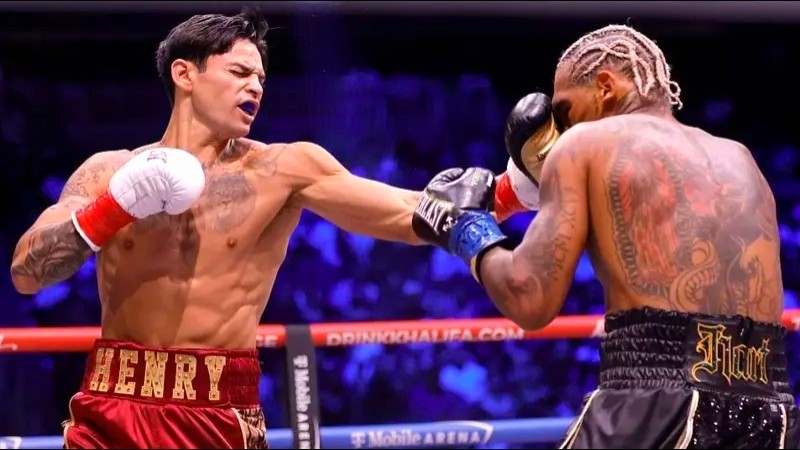
Boxers can win a fight in one of several ways. First, by knocking out their opponent. If any part of a fighter touches the canvas floor of the ring with any part of their body other than the feet as a result of an opponent?s punch, as determined by the referee, the referee begins counting to eight. The fighter must return to his or her feet during this time, and the referee will determine if the fighter can safely continue. If he or she cannot, the referee stops the fight and the result is a knockout. On occasion, fighters cannot get off the canvas, or are unconscious, and the knockout is more obvious.
The bell signaling the end of the round cannot ?save? a fighter. The count will continue past the bell if necessary. The bout can end after the round is officially over if the fighter cannot continue.
A boxer can also win by technical knockout or TKO. If the referee intercedes and stops the fight, declaring a boxer unable to continue because of serious cuts, bruises, or other damage; or because he or she cannot physically go on, or is being punched and cannot defend themselves, a TKO win is declared. Example of a boxing scorecard, this one from the recent Quillin vs. Lee middleweight fight. Photo: CompuBox
Boxing Scorecards and Judging a Fight
When both boxers finish all 12 rounds, three judges determine the winner using a ?10-point must system.? Judges give the winner of each individual round 10 points, and the loser gets nine points. If a fighter is knocked down, he loses a point for each knockdown per round. Scores can be 10-9, 10-8, and so on. Referees can also deduct points for fouls or infractions after warnings. Scores in this case can be 9-9, 9-8 and so on.
Judges base their evaluation on multiple factors including number of punches, strength of the punches, ring movement, ring generalship, defensive skills, speed, footwork, and aggressiveness. Punches to the head and to the body count. Punches blocked or landing on the arms do not count. It is somewhat subjective, so many fights have controversial results when fans disagree. When all three judges agree, the boxer wins a unanimous decision. When two of three agree, it is a split decision. When two of three agree and a third judge scores neither boxer a winner (a draw), it is a majority decision. Fights can also end in draws or disqualifications. Manny Pacquiao, a southpaw, knocked out Ricky Hatton with a left hook.
Boxer Characteristics
Boxers are right handed and left handed. An orthodox boxer (like Mayweather) is right handed. He uses his left hand to punch first (or lead), and his right hand delivers the power punches. Southpaw fighters (like Pacquiao) are the opposite. The lead hand is the right, the power hand is the left. This also changes the way the fighters stand, with opposite feet in front. Imagine ballroom dancing with someone whose left foot is in front against your opposing right foot in front. You don?t fit together well. This can create problems due to stepping on each other, tripping, or both fighters leaning in with their heads and butting each other.
Types of Punches
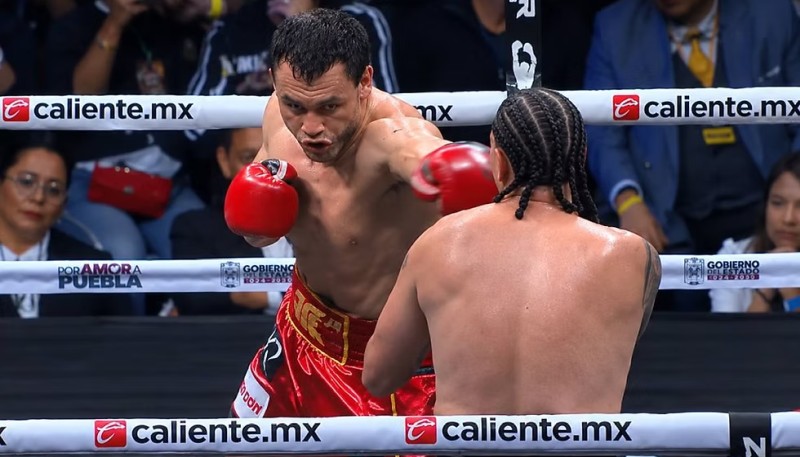
There are four basic punches: Jabs, crosses, hooks, and upper cuts, thrown from the right or the left. Jabs are important because they provide defensive cover while also testing distance and the chin or fitness of the opponent. Crosses are powerful straight punches thrown with the dominant hand. Unlike the jab, crosses involve a weight transfer from back foot to lead foot to maximize the force behind the punch. Hooks are semi-circular punches thrown to the side of a boxer?s head or body. Upper cuts are punches thrown upward underneath an opponent?s chin.
CompuBox is a computerized punch scoring system, which counts the different type of punches, and also categorizes punches into type include power punches, which are any punch other than a jab that lands to the head or body. You will see CompuBox statistics provided throughout the broadcast. Floyd Mayweather shows off the shoulder roll defense in his fight against Canelo Alvarez. Photo: Tom Casino, Showtime
Boxing Defenses
Equally important are defensive skills. Defensive skills involve a lot more than simply holding your hands up in front of your face. Physical movement around the ring, head movement, feints, and rolling back away are all employed. Floyd Mayweather is a master of the defensive arts in boxing. If you cannot be hit, you cannot be hurt. Making yourself as small a target as possible by angling your body is an art form in the hands of someone like Mayweather.
Boxing Styles
Boxers tend to be defined as a certain type or style of fighter. A pure boxer relies on technical skills, speed and grace to win, using distance and defense. They do not rely on knockout punching power, even if they are capable of it. Floyd Mayweather is perhaps the world?s greatest pure boxer and a defensive technical genius.
A counterpuncher strikes when his opponent makes a mistake, or in response to a punch thrown by his opponent, measuring and taking advantage of gravitational force as his opponent move forward. When the man moving forward and the punch connect, it amplifies the power of a connecting punch. This is the classic counterpunch knockout. Mayweather is also a capable counterpuncher.
A boxer-puncher employs equal parts punching and boxing skills, amplified by speed, or power, or aggression. At times, Manny Pacquiao has been all of these things. Adding the southpaw challenge to the equation can make this type of fighter exciting to watch, and versatile. But he can be vulnerable to the counterpuncher, or frustrated by the defensive fighter. Juan Manuel Marquez and Manny Pacquiao are considered fighters whose styles are well matched for exciting action. Photo: HBO
Styles Make Fights
Boxing purists often say, ?Styles make fights.? When the individual styles of each boxer compliment each other and create the potential for a lot of activity, the fight is generally more exciting. Imagine two careful defensive boxers in the ring. They both have a lot of technical skill but they watch and wait, and the fight can be very boring to fans. Two Mayweathers in the ring would make for a dull fight. He needs an opponent who will go after him, and Pacquiao is one of those opponents. The $1 million belt with 3,000 emeralds the winner will receive from the World Boxing Council. Photo: HBO
Championship Titles and Belts
Boxers who are champions in their weight division win a title, symbolized by a belt. There are several major sanctioning agencies, which has led to multiple belts and often multiple champions. Three belts are at stake in this fight. Floyd Mayweather has two of them, and Manny Pacquiao has the other. But the title both covet most is currently vacant. Mayweather gave it up when he temporarily retired seven years ago. Now with the number one and number two ranked fighters in this division meeting, the winner will claim what is known as the ?lineal championship.? Pacquiao can set a record of five lineal championships if he wins Saturday.
Pound For Pound Ranking
When judging fighters, they are referred to as the ?best pound for pound fighters.? There will never be fights between the best heavyweight and smaller fighters, for example, so there are not true playoffs as with other sports. They are judged by overall record, overall quality of their opponents, skills, toughness, aggression, defense, and longevity.
For many years, Floyd Mayweather and Manny Pacquiao have both been at the top of the various ?Pound for Pound? best rankings lists. They are now first (Mayweather) and second (Pacquiao). It is rare two men at the top of the lists face each other in the ring. This is one among many reasons Saturday?s fight is so highly anticipated. Whoever wins will reign as boxing?s best pound for pound fighter, the MVP and Player of the Year in this sport.