When Erik Morales (48-4, 34 KOs) and Manny Pacquiao (42-3-2, 32 KOs) lock horns at the Thomas & Mack Center in Las Vegas on Saturday, they will be looking to add an explosive finale to their own chapter in boxing history. Their first meeting, in March 2005, was so enthralling it merited a replay. When Pacquiao, who had been cut and outpointed by a regal Morales on that day, stormed back from a slow start to overpower and stop his Mexican foe in the rematch this past January, it mandated a third, deciding bout.
And should Saturday’s fight prove to be anything close to as pulsating as its predecessors, then Morales and Pacquiao may enter boxing’s annals in the same way as, for example, Leonard and Duran, Bowe and Holyfield — or, for that matter, Morales and Barrera: forever linked as partners in a three-pronged fistic dance.
They’re hyphenates,” boxing historian Bert Sugar said of boxers who have become renowned for the trilogies they fought against each other. “You almost can’t say Frazier without saying Ali. You can’t say Graziano without Zale. Frank Sinatra once had a song called ‘Love and Marriage.’ You can’t have one without the other. It’s like Gilbert and Sullivan. It’s like Cain and Abel. We tend not to remember any other of their goddamn fights.”
Trilogies evolve for a variety of reasons, explained Sugar.
“Some are convenience. Some are box office. And yes, some may be looking for revenge, but it may not be revenge against the other person so much as for the loss on their r?sum?.”
One thing trilogies generally do have in common is that the first fight is almost always exciting, eventful, or controversial enough to sustain the public desire for more, even if the return match is a relative disappointment — which, in several cases (for example, Ali-Frazier, Gatti-Ward or Barrera-Morales) it has been. Jose Luis Castillo dominated Diego Corrales in their second fight last year, knocking him out in the fourth round. But the first fight — in which Corrales had recovered from two 10th-round knockdowns to stop Castillo in the same frame — had been so spectacular, and the controversies surrounding the rematch (specifically, the fact that Castillo had not made weight and thus was perceived to have a physical advantage over Corrales) so mitigating that there remained the clamor for a decider, and there would have been one had Castillo not failed to make weight again.
The initial bout in a series, whether for a title or not, may be an upset, but if the favored fighter gains revenge too easily, then the first result may be officially designated a fluke and the series may end at two. Case in point: when Lennox Lewis lost his heavyweight championship to a thunderous Hasim Rahman right hand in 2001, it was widely attributed to Lewis’ slovenly approach to training and acclimatization to the South African altitude. When he thoroughly dominated Rahman in the rematch in Las Vegas, separating him from his senses with a sweeping overhand right in the fourth round, the point was made. Rahman had won the first time because Lewis’ eyes had been off the ball. When he suggested a rubber match, Lewis laughed.
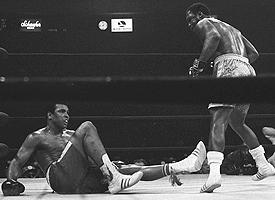
Conversely, although Muhammad Ali avenged his shocking March 1973 points defeat to Ken Norton (in which Norton broke his jaw) with a decision victory of his own in September the same year, the manner of his triumph was far from decisive. It took three years — during which time Ali spectacularly regained the heavyweight title by beating George Foreman, and completed a trilogy with his true, great rival, Joe Frazier — but eventually Ali and Norton tangled a third time. Again, although Ali was adjudged to have triumphed, it was whisker close.
In completing epic trilogies against two men — Norton and Frazier — Ali joined an elite fraternity, of which Morales will become the newest member on Saturday night when he puts the (presumably) finishing touches to the Pacquiao phase of his career and places the plaque on his mantelpiece next to his commemorative Marco Antonio Barrera trophy. The great Mexican bantamweight Ruben Olivares is in the same club, fighting Chuco Castillo three times in 1970 and 1971, and completing a triad of battles with Bobby Chacon in 1973, 1975 and 1978.
Chacon would have joined them had his three fights with Bazooka Limon not spawned a fourth. Indeed, boxing history is more replete with rivals who passed through three fights on their way to four, five, six or more than it is with fighters who completed a trilogy and stopped there.
AP Photo Jake LaMotta, left, and Sugar Ray Robinson fought six times. “The third Robinson-LaMotta fight marked a trilogy,” Sugar said. “Then there was a fourth fight, a fifth fight, a sixth fight.”
Among modern fighters, perhaps the champion at fighting opponents multiple times was Argentine light heavyweight Victor Galindez. Among his 70 bouts, he counted five against Jorge Ahumada, six versus Avenamar Peralta, and nine against Juan Aguilar. But even his record pales against some of the sport’s true old-timers.
The legendary Sam Langford, for example, fought Harry Wills 18 times, Sam McVey 15 times, and Joe Jeannette on 13 occasions — partly because, as a black man boxing in the early 20th century, there were only certain opponents he was able to fight, and partly because, as HBO’s Harold Lederman observed, boxers once fought far more frequently than they do now.
“You’re not going to get another Sugar Ray Robinson-Jake LaMotta six-fight series, because guys just don’t fight that often. LaMotta and Robinson, I think, fought two of their epic battles two [in fact, three] weeks apart. And I think Robinson may have had a fight in between,” he said.
Particularly in Langford’s time, noted Lederman, “There was no television and they wanted more people to get the opportunity to see them fight, and people would pay for it. In those days, they were paying the fighters based on gate receipts. So a guy like Langford wants to make money, he’s going to fight the most exciting guy that he can, bring in the most amount of dollars at the door, so that if he’s getting a percentage — let’s say he’s getting 10 percent, something like that — at least he has an opportunity to make a lot of money. So of course he fought Wills God knows how many times, or Jeannette God knows how many times, because people couldn’t see it on TV, they had to go to the arena and see the fights. So if it was a great fight, he’d say to Wills, ‘Hey, let’s do it again.'”
Today, even if fighters were inclined to fight often enough to allow such series to develop, fans would almost certainly start losing interest before long, no matter how good the fights. Of course, some recent trilogies have taken place even without fan demand. The heavyweight series between Evander Holyfield and John Ruiz may have been closely fought and controversially scored, but few were slavering for the second, let alone the third, and even though the rivalry ended all square, with one win apiece and a draw in the third bout, nobody was beating down the door for a fourth battle to settle it all.
Bernard Hopkins fought Robert Allen a second time, in February 1999, because their first contest, 5? months earlier, had had such a bizarre and inconclusive ending: Referee Mills Lane, attempting to separate the two fighters from a clinch, accidentally shoved Hopkins out of the ring and to the arena floor, injuring the middleweight champion and causing the bout to be declared a no-contest. The rematch, however, was one-sided, Hopkins dropping Allen in the second and sixth rounds and stopping him in the seventh. There was no interest whatsoever in a third go-round, but by 2004, Allen had worked himself up to mandatory contender status; once again, Hopkins dominated him, this time en route to a pedestrian 12-round decision.
Similarly, there was a period when Bronco McKart seemingly couldn’t avoid Winky Wright even if he wanted to — and by the end, he must indeed have wished he had. The first time they met, in 1996 for McKart’s WBO junior middleweight belt, it was a close affair, with Wright prevailing by split decision. When they next fought four years later, in an eliminator for the IBF title, Wright was much improved, and eased to a dominant, unanimous points verdict. By the time they faced off a third time, McKart now challenging Wright for that IBF title, Wright’s superiority was total, and the flummoxed McKart, unable to mount any meaningful offense, was disqualified for repeated low blows.
Steve Grayson/WireImage.com Antonio Tarver (right) had Jones on the ropes in their first bout, but Jones prevailed. Tarver would take the next two meetings. On the other hand, the series between Roy Jones, Jr. and Antonio Tarver, two local rivals with genuine disdain for each other, had all the ingredients for a classic trilogy.
Their first fight, in November 2003, was a barn burner; Jones was forced to cover up against the ropes as Tarver bombarded him, but Jones was able to seize control with his hand speed when the action moved to center ring. The result was a disputed majority decision for Jones, but if it was a shock to see Jones — who had barely lost even a single minute of a single round over the past decade — struggling so mightily in that first fight, it was as nothing compared to the reaction when Tarver poleaxed him with a left hand down the middle in the second round of their rematch. Twelve thousand souls stood, mouths agape, in disbelief at seeing the pound-for-pound king knocked out by his hated foe.
The stage was set for an enthralling rubber match. But Jones was knocked out cold in a supposed tuneup by Glen Johnson, who then went on to beat Tarver, before Tarver outpointed Johnson in a rematch. By the time Tarver and Jones did meet again, they were both severely damaged goods, and what little action there was in the third fight served only to highlight how far both men had fallen, and how fast.
Because Morales has lost three of his last four fights (including the second bout with Pacquiao and the third fight with Barrera), there is a sense that he, too, may be at the end of the road. Unlike Jones and Tarver, however, few expect him to go out with a whimper. There is every possibility that, by Sunday morning, Morales and Pacquiao will already be regarded with the same reverence as some of the great trilogies before them.
“I think people are excited by Morales-Pacquiao, not just because it’s Erik Morales and Manny Pacquiao, but because they’re saying, ‘We saw these guys twice before, they fought two great fights, we want to see another great fight,'” Lederman said. “The first two fights were great, and I think the third fight’s going to be great. I’m expecting nothing but a knock-down, drag-out war from the get-go. I can’t see Manny Pacquiao running away, I think he’s going to come right at Erik Morales, and I think Morales is going to be ready with that huge right hand. I think it’s going to be an exciting fight, and I’m really, really looking forward to it.”
Click here for the list of our top 10 trilogies in the history of boxing. Then, SportsNation wants you to vote on the best boxing trilogy.
Kieran Mulvaney is a freelance writer based in Washington, D.C. He covers boxing for ESPN.com, Reuters and TigerBoxing.com.



